
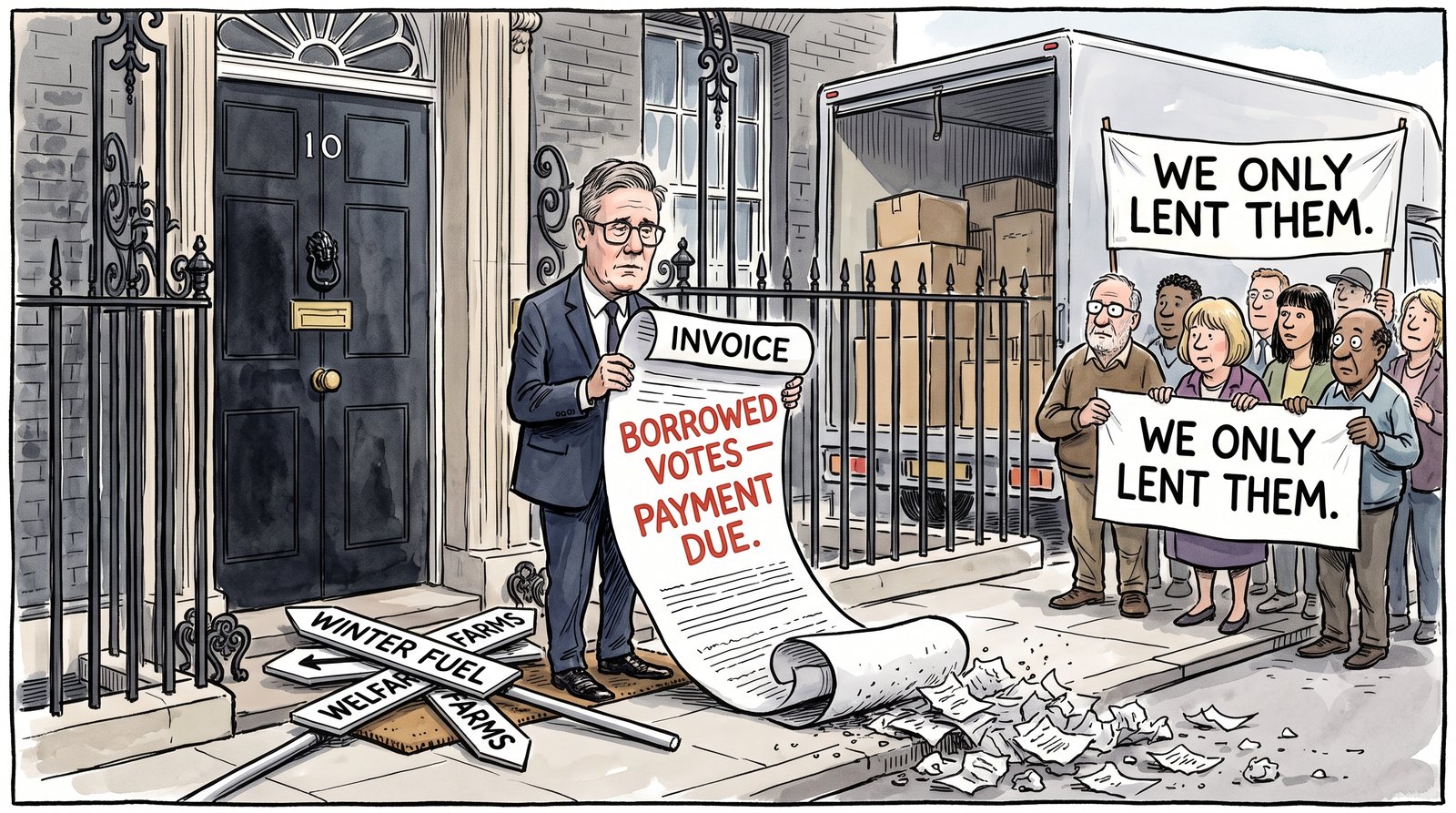
Keir Starmer failed for a reason that was visible on the morning he won. He took 411 of the 650 seats in the House of Commons on roughly 34 percent of the vote, the loveless landslide, and then governed as though the seats were the mandate. On 22 June 2026, less than two years in, he told his party he had heard their answer and resigned the leadership. He stays in Number Ten only as a caretaker until a successor is chosen.
Start with the arithmetic, because it explains almost everything that followed. A Commons majority of more than 170 looked like strength. The vote share underneath it did not. Most of that vote was a verdict on fourteen years of Conservative government, not a contract with Labour. Borrowed votes have to be earned a second time, in office. Starmer never did the earning.
The collapse was the fastest on record. Ipsos had his net approval at minus 60 by May 2026, the worst score it has recorded for any prime minister two years into the job. By late June the poll averages put Reform on 27 percent, Labour and the Conservatives tied on 19, and the Greens within reach on 14. A governing party of under two years was running third in the country it governed.
The texture of the failure was a sequence of U-turns, and each one cost more than the policy it reversed. The winter fuel payment was stripped from most pensioners in the first months, then handed back after the May 2026 local elections wiped out nearly 1,500 Labour councillors, 38 councils, the Senedd in Cardiff and further ground in Scotland. The welfare bill was rewritten about ninety minutes before the vote, with eligibility for Personal Independence Payment parked behind a review, because the government could not carry its own benches. The inheritance tax raid on farmers was softened after the rural backlash. The statutory inquiry into grooming gangs was resisted for months, then conceded once Baroness Casey's report made resistance untenable.
Govern by reversal often enough and you teach two lessons at once. You tell your opponents that pressure works, and you tell your own side that the leadership holds no settled view worth defending. A U-turn on a bad policy is prudence. A U-turn as a habit is a confession that nobody decided what the policy was for.
That is the silence at the centre of the Starmer years. Ask what Starmerism stood for and the honest answer, even from inside the tent, was that nobody could say. There was competence as a promise and process as a substitute for direction. The clearest evidence is what his own resignation statement did not contain. It named no project left unfinished, no idea worth fighting on for one more year. He said he had heard the answer of his parliamentary party. A leader with a cause does not resign on a headcount.
The proximate trigger was self-inflicted. Starmer sent Peter Mandelson to Washington as ambassador, then had to recall him in September 2025 when documents set out the depth of his ties to Jeffrey Epstein. The cabinet resignations followed, Wes Streeting from Health in May 2026 and John Healey from Defence in June. When Andy Burnham won the Makerfield by-election on 18 June and the parliamentary party found its voice, the end took four days.
It is fair to him to say the inheritance was grim and the headwinds were real. Public services were threadbare, the fiscal room was thin, and no plausible Labour leader was going to enjoy 2025. But scarcity is not an alibi for having no answer to the question of what the scarcity was for. Governments that endure through hard years are the ones that can name the trade they are asking the country to accept. Starmer never named it.
Here is the part that should worry whoever comes next, including those of us on the centre-right who might be tempted to enjoy the spectacle. The deepest cause was structural, not personal. First past the post manufactured a majority far larger than the vote that produced it, and a manufactured majority hides its own fragility until the day it does not. Reform did not win the argument on policy. It collected the protest of an electorate that feels unrepresented by either main party, the same anger reshaping politics across the West. Replace Starmer with a more vivid leader and the structural problem, a system that rewards seats over consent and offers management where it owes a purpose, sits exactly where it was.
Burnham, the likely successor, inherits the arithmetic, not a fresh start. Reform on 27 percent and a parliamentary party that has just learned it can remove a leader is not a platform for stability. A new face buys months, not a mandate. The real test is whether Labour can say, in one sentence a voter would repeat, what it is in government to do. If it cannot, the next collapse is a question of timing.
Starmer's real failure was not the winter fuel cut or the Mandelson misjudgement, costly as both were. It was treating a borrowed majority as a settled argument, and discovering, too late, that in politics the bill for borrowed votes always comes due.