
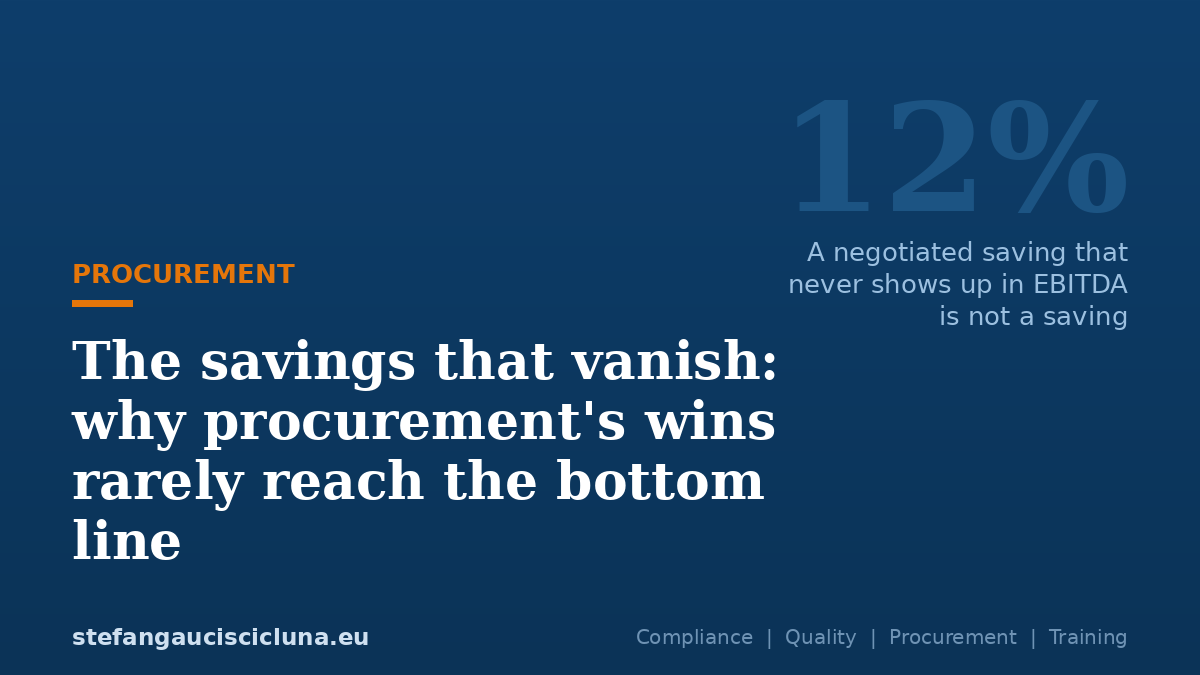
Every procurement team has a number it is proud of. We took 12 per cent off the logistics contract. We beat the incumbent down 15 per cent. The slide looks great, the buyer gets a pat on the back, and the saving is booked. Then the year ends, the finance director looks at the actual spend, and the money is not there. Nobody lied. The saving was real on the day it was signed. It just leaked away before it reached the accounts.
This is one of the least discussed and most expensive problems in buying. Bain and Company describe it plainly: a large share of the savings procurement negotiates never shows up in earnings, because the gap between a negotiated price and realised value is full of holes.1 If you sign off supplier spend, this is your money quietly disappearing, and the slide deck is hiding it.
Where the money actually leaks
The leaks are boringly consistent once you look for them. The contract is signed but people keep buying off the old one, or off no contract at all. The negotiated rate applies to a volume nobody hits. Prices creep back up at renewal while nobody is watching. Extra fees, minimums and specification changes eat the discount. The saving was measured against a baseline that was never real. Each hole is small. Together they are the difference between the number on the slide and the number in the accounts.
The fix is not harder negotiation. It is tracking.
The instinct when savings disappear is to negotiate harder next time. That is the wrong lever. You do not have a negotiation problem, you have a realisation problem, and the answer is to track a saving from the day it is agreed to the day it lands, the way you would track any other asset you cared about. Most organisations track savings up to the handshake and then stop, which is exactly where the leaks begin.
The solution, as a savings-realisation tracker
Follow every saving to the P&L
| Stage | The question | Who owns it |
|---|---|---|
| 1. Baseline agreed | Is the "before" price real and signed off by finance? | Buyer + finance |
| 2. Contracted | Is the new price actually in a live contract? | Buyer |
| 3. Implemented | Are people buying on it, or off the old habit? | Budget holder |
| 4. Realised | Does the invoice match the negotiated price? | Finance |
| 5. Sustained | Has it held at renewal, or crept back? | Buyer |
A saving is only counted at stage 4, verified against invoices. Everything before that is a forecast, not a result.
The single most powerful move on that table is having finance, not procurement, confirm the baseline and the realised number. The moment the people who own the P&L verify the saving against real invoices, the theatre stops. You can no longer claim a win against a baseline you invented, and you can no longer lose a real saving to maverick buying without someone noticing. It turns procurement from a function that reports promises into one that reports money.
Questions to ask about your last big saving
- Was the baseline a real, signed-off price, or a convenient one?
- Is the negotiated rate in a live contract people are actually buying on?
- Has finance confirmed the realised number against invoices?
- What happened at the first renewal, did the price hold?
- If the money is not in the accounts, why are we still counting it?
Negotiating well is the easy, visible part of procurement, and it is where all the attention goes. Making the saving survive the trip to the bottom line is the hard, invisible part, and it is where the value actually is. Track every saving to the invoice, let finance own the baseline and the realised figure, and watch how many of your celebrated wins turn out to be real. Some will. The ones that do are worth more than any slide, because they are money you can actually spend.
Notes and sources
From the book
Procurement That PerformsTurn supplier spend into growth and performance, using AI where it earns its place, with no procurement team.