
Compliance
Compliance Beyond Ticking the Box
Turn compliance from a cost you endure into a system that protects the business and drives its growth.
View on Amazon →Writing
I write about business, economics and public policy in whatever format suits the argument. Long-form essays that show the working. Shorter policy analysis and opinion. Editorial cartoons when a picture lands harder than a paragraph. Video when the point moves better than it sits still. And commissioned work for organisations that want the same clear, sourced approach applied to their own subject.

Enterprise and competitiveness, capital and investment, and the firms that create the wealth.
02Growth and productivity, public finances, and the housing and cost-of-living questions underneath them.
03The EU, the UK and Malta, read against each other: three answers to the same questions.
Long-form pieces and columns, grouped by theme: economy and work, education and skills, governance, Europe and Malta.
Op-eds, policy briefs, reports, ghostwriting and strategy documents, written to your brief and to a fixed price.
The week in one drawing, when an argument is sharper as a picture than as prose.
Selected talks, explainers and appearances worth your time.
Longer-form writing, as practical books. Step-by-step workbooks and reference guides alike, built on real, documented company cases from the UK, Europe and the USA.
Compliance
Turn compliance from a cost you endure into a system that protects the business and drives its growth.
View on Amazon →
Compliance
Fifty-eight models of governance, risk and compliance, each explained and anchored to a real, sourced case.
View on Amazon →
Compliance industry
Fifty business-model patterns behind the compliance industry, each carried by a real, named company.
View on Amazon →
Procurement
Turn supplier spend into growth and performance, using AI where it earns its place, with no procurement team.
View on Amazon →
Quality assurance
Fifty models and standards of quality assurance, each told through a real, sourced case.
View on Amazon →
Learning & development
Make the courses you pay for actually change what your team does, and prove it, with no training department.
View on Amazon →Thirty short, practical reads drawn from the six books, each built on a real, documented company case, with the statistics sourced and a different working tool on every page. Grouped by book. For the one-minute versions, one model at a time, see Business Insights.
Making the training you pay for actually change behaviour, and proving it.
Learning & development
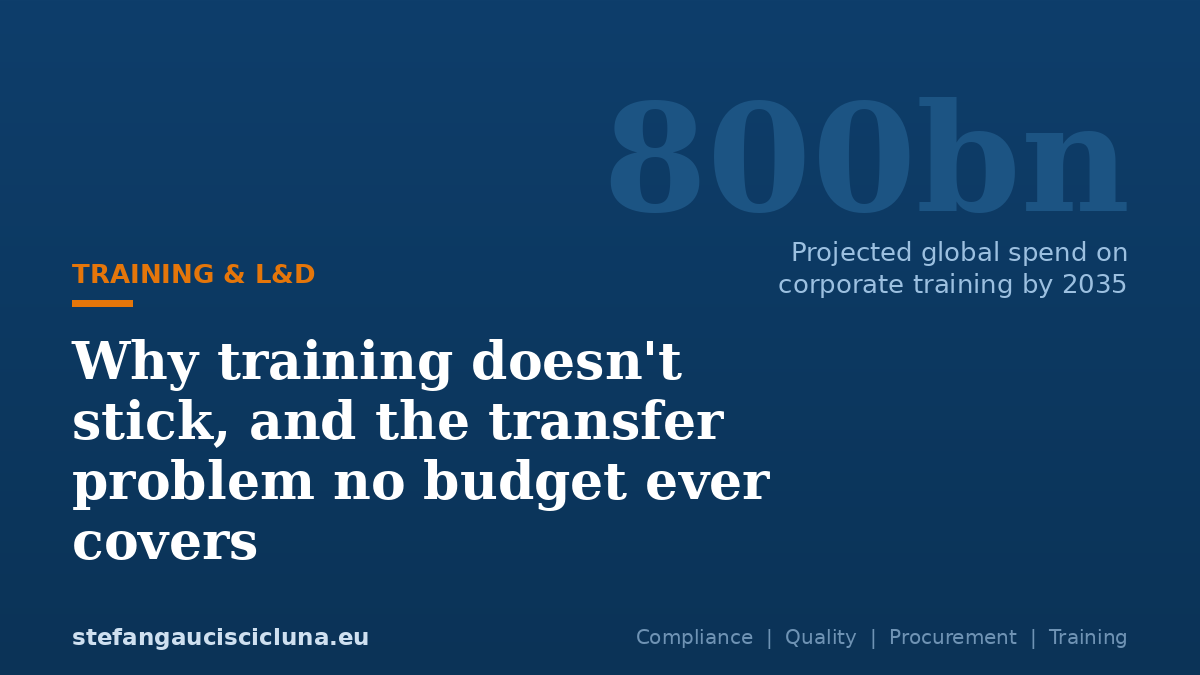
Companies will spend their way to roughly 800 billion dollars a year on training by 2035, yet most of it never changes what people do on the job.
Learning & development
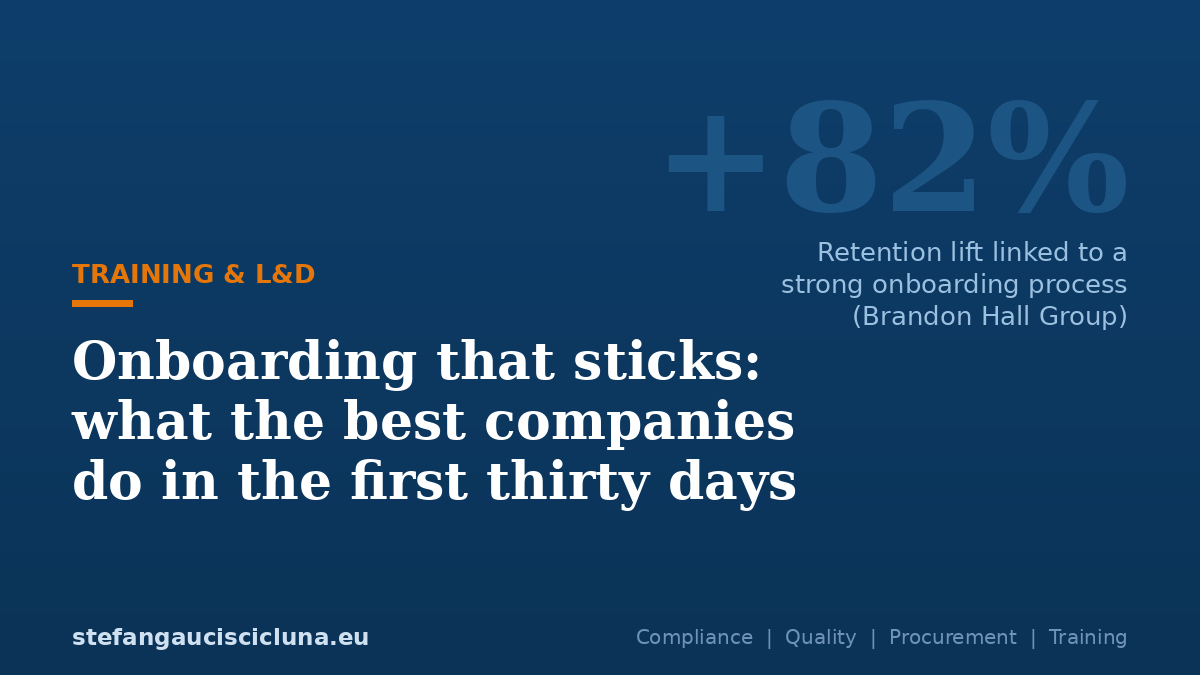
Strong onboarding has been linked to 82 per cent better retention and 70 per cent higher productivity, and one of the most cited gains in the...
Learning & development
Completion rates and happy-sheets are the two numbers that prove nothing and get quoted the most.
Learning & development
The one-day workshop feels efficient and forgets fast.
Learning & development
After a 1978 crash where a competent crew ran out of fuel while distracted, aviation rebuilt its training around realistic scenarios and human...
Turning supplier spend into growth, performance and resilience.
Procurement
A team negotiates a hard 12 per cent off a big contract, everyone celebrates, and a year later the finance director cannot find the money.
Procurement
Every vendor now sells an AI that will transform your buying.
Procurement
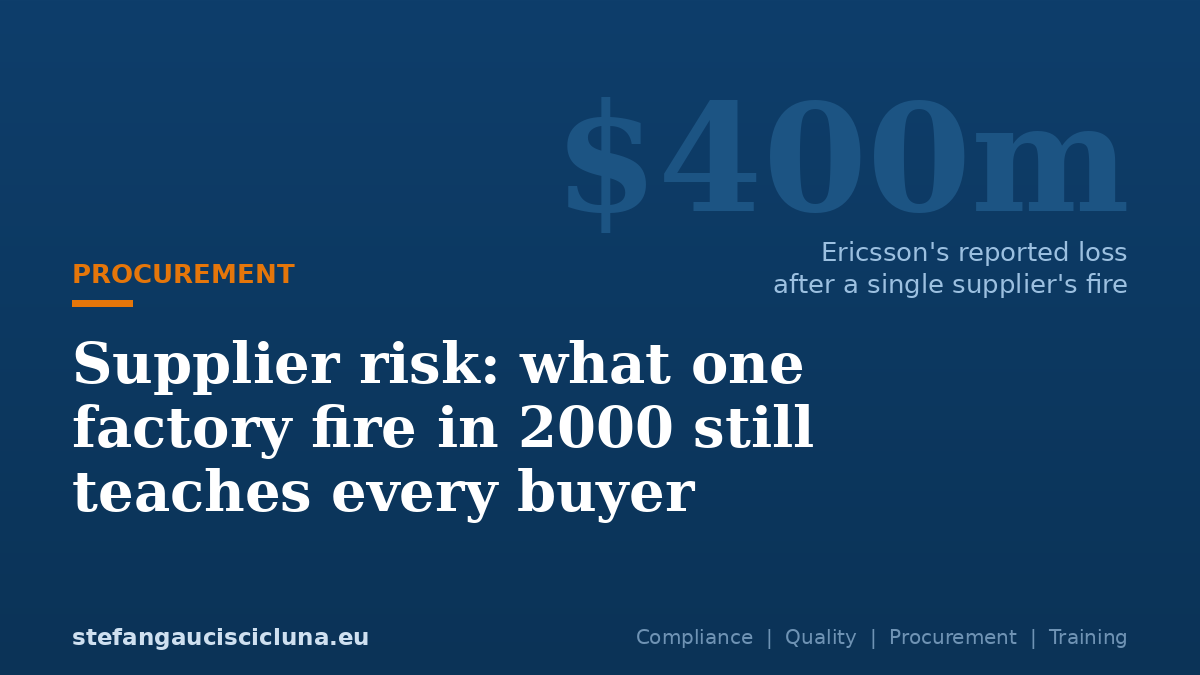
A ten-minute fire at a chip plant in New Mexico hobbled Ericsson and barely touched Nokia, buying from the same supplier.
Procurement
Most organisations control the twenty per cent of suppliers that make up eighty per cent of spend, and ignore the long tail.
Procurement
The person who ran Apple's supply chain became its chief executive.
Turning compliance from a cost you endure into a system that protects and pays.
Compliance
Wells Fargo had a code of conduct, an ethics line and mandatory training while staff opened around 3.5 million accounts nobody asked for.
Compliance
At Wirecard, warnings about a 1.9 billion euro hole were raised for years and waved away, until the company collapsed.
Compliance
A record 1.2 billion euro GDPR fine for Meta.
Compliance
Every compliance programme talks about tone from the top.
Compliance
Most organisations respond to a regulator's finding by fixing the symptom, closing the action and moving on, until the same problem returns under...
The frameworks that decide whether a business is protected or exposed, in plain language.
Compliance
HSBC had three lines of defence on paper and still moved hundreds of millions for the wrong people, paying 1.9 billion dollars in 2012.
Compliance
Most owners think a compliance management system is a folder of policies.
Compliance
COSO is the framework auditors quote and everyone else nods along to.
Compliance
Ask a board how much risk it is willing to take and you usually get a speech, not a sentence.
Compliance
Owners often think they must choose between the big compliance frameworks.
How compliance creates advantage, wins budget, and how the industry itself makes money.
Compliance industry
Most firms treat compliance as the department that says no.
Compliance industry
The compliance industry is enormous and strangely invisible.
Compliance industry
Compliance leaders lose budget arguments because they bring fear to a fight that is decided by numbers.
Compliance industry
Bolted-on compliance is the second desk you visit after the work is done, the sign-off that slows everything and catches little.
Compliance industry
Uber and Airbnb both grew fast by treating local rules as obstacles to out-run.
The models and standards that build quality in, rather than inspect it out.
Quality assurance
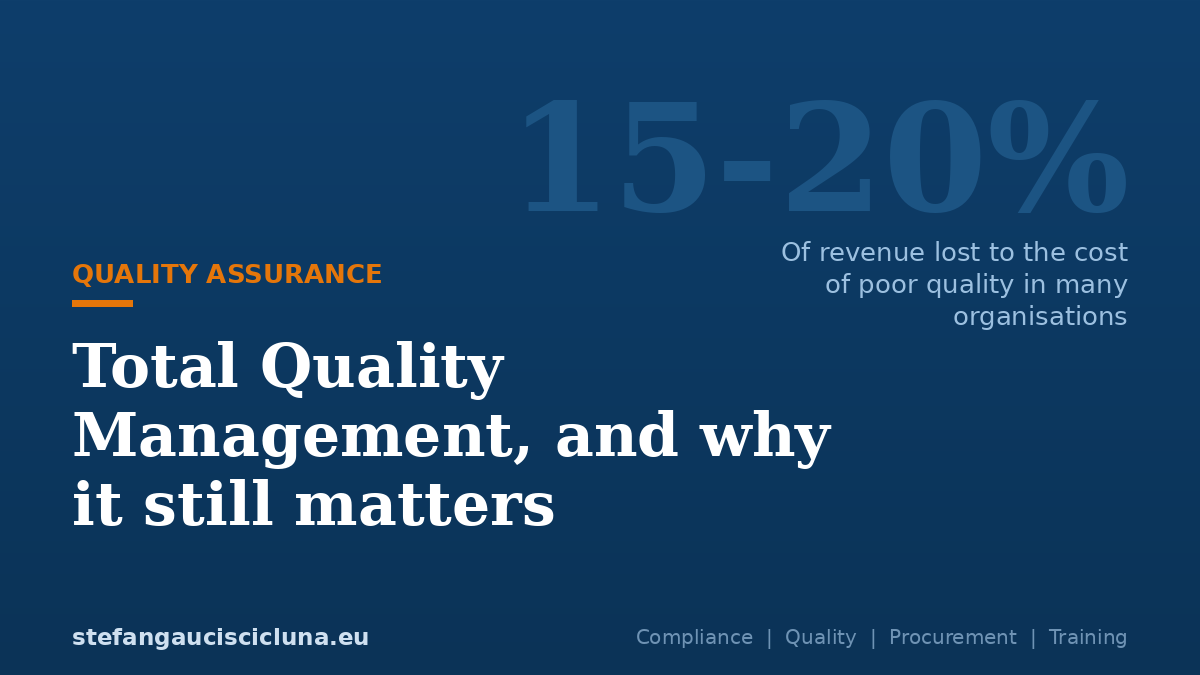
TQM sounds like a relic of 1980s manufacturing.
Quality assurance
Six Sigma got wrapped in coloured belts and Greek letters until it sounded like a cult.
Quality assurance
Most ISO 9001 certificates hang on a wall while the business runs exactly as it did before, now with more paperwork.
Quality assurance
Toyota built the most admired manufacturing system in the world not through big transformative projects but through a relentless habit of tiny...
Quality assurance
Most businesses know if this month was good.
Honesty on the big issues is a good start. The missing piece is training at work, better managers and councils people can reach.
The ten least corrupt countries rely on rules that bind whoever wins. What they do about politics and business, and what Malta has not done.
Better rules will not fix a culture that pays for the wrong things. Why incentives, not missing reports, are the deeper problem.
The EU is cutting €37.5 billion of administrative cost against a €750 to €800 billion annual investment gap. Simplification is about five per cent of the diagnosis.
UK public wealth went from a quarter of national income in 1970 to minus £695.7 billion. Where it went, and how to rebuild the state as a shock absorber.
Meta is on trial in California over a design its own research examined behind closed doors. The case for legislating a new model, and what the UK, EU, Australia and Malta are doing.
A note on commentary
Most of the writing is analysis: trade-offs set out, sources shown, a clear line between what the evidence says and what I think. There is one strand where I drop the neutral register and make an argument openly, including on politics and public life. It is always signposted, so you know when you are reading analysis and when you are reading an opinion. You can find it collected in the commentary.
Business and enterprise, economics and growth, and public policy and institutions, across the European Union, the United Kingdom and Malta. Analysis is kept separate from opinion, and every claim shows its source.
Long-form essays, shorter opinion and policy analysis, editorial cartoons, and video, alongside commissioned work written to a client's brief.
The Portfolio page collects every published essay and article, grouped by theme, alongside the editorial cartoons, selected video, and the books.
Yes. The Work with me page covers op-eds and columns, policy briefs, reports and white papers, speeches and ghostwriting, and strategy documents, each priced per brief.