
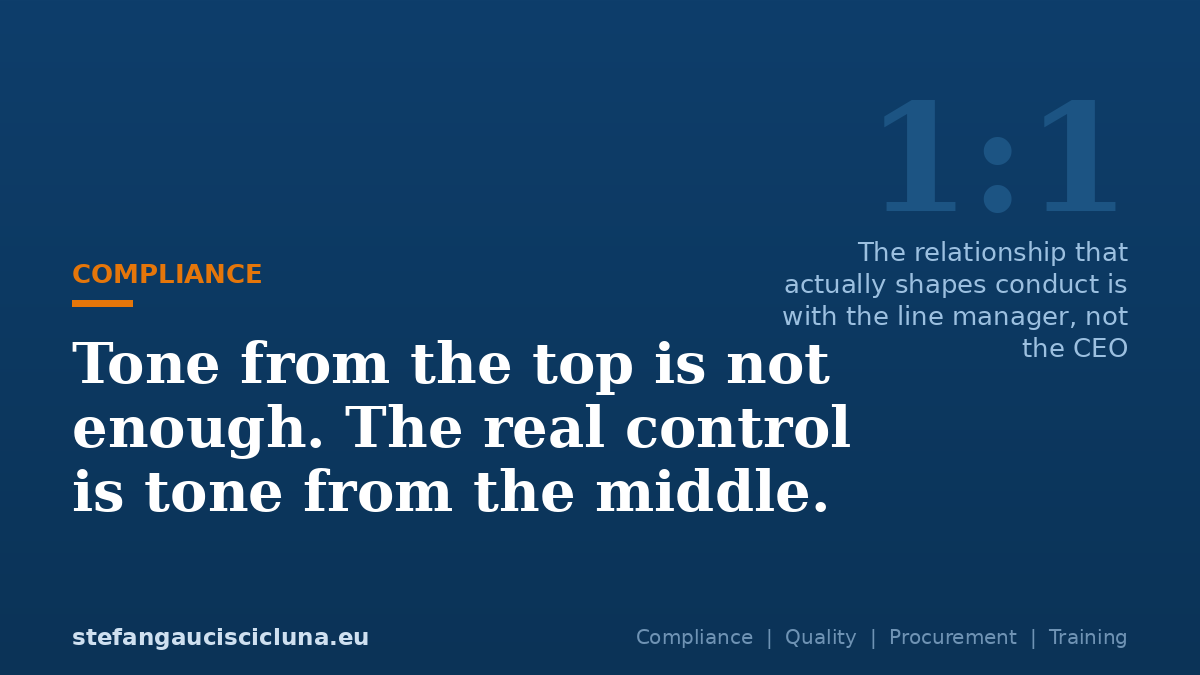
Open any compliance programme and you will find a line about tone from the top. The board sets the ethical example, the chief executive signs the values statement, and this is supposed to cascade down through the organisation. It is not wrong. It is just not where conduct is actually decided. Most of your people have never had a real conversation with the chief executive. They have one every day with their line manager, and that is the relationship that governs how they behave when a rule meets a deadline.
The 737 MAX story is, at bottom, a middle-management story. The top of Boeing talked about safety. What reached the engineers and the floor, through their immediate managers, was schedule and cost pressure that made raising a concern feel like being the problem.1 The values on the wall said one thing. The manager in the room rewarded another. People are not stupid. They follow the signal that pays their mortgage, which is the one from the middle.
Why the middle is where compliance lives or dies
The line manager holds the three levers that actually move behaviour: what gets praised, what gets overlooked, and what gets someone in trouble. If a manager quietly rewards the person who cut the corner and hit the number, no code of conduct survives contact with that. If a manager visibly backs the person who slowed down to do it right, no scandal is likely to start on their team. The board's tone is a broadcast. The manager's tone is the weather people actually live in.
The problem: we train managers on everything except this
We train managers to plan, to run meetings, to do appraisals. We almost never train them on their single most important compliance job: being the control. Most managers do not even know it is their job. They think compliance is a department down the corridor, not something they enact every time they react to a corner being cut. So they default to rewarding output and treating the rules as someone else's problem, which is exactly the gap every serious failure grows in.
The solution, as a manager's control card
Give every manager these five duties, in writing
- Notice the corner being cut. Your silence when it happens is your loudest signal.
- Reward the right behaviour visibly, especially when it cost time or a number.
- Make it safe to raise a concern to you, and act when someone does.
- Never let a target quietly override a rule without saying so out loud.
- Escalate what you cannot fix, rather than absorbing it and hoping.
How to know if your middle is holding
You cannot read tone from the middle off a policy. You read it off stories. Ask around: what happened to the last person who slowed a job down to do it properly, and what happened to the last person who cut a corner and hit the target. The answers, which everyone in the team already knows, tell you your real control environment far better than any attestation. If the corner-cutter did well and the careful one paid for it, your tone from the middle is broken, whatever the top is saying.
Questions to test tone from the middle
- Do our managers know that being the control is part of their job?
- What happened to the last person who put a rule ahead of a target?
- Where do our incentives ask managers to reward the wrong thing?
- Can people raise a concern to their own manager safely?
- Are we training managers on this, or only on planning and appraisals?
Tone from the top matters, and a board that signals the wrong values will poison everything below it. But it is necessary, not sufficient. The control that actually governs conduct is the line manager, day in and day out, through what they reward and what they let slide. Name that duty, put it in writing, train for it, and check it by listening to the stories people tell. Get the middle right and the top's values finally reach the ground. Ignore it and the values stay on the wall, where the next scandal will find them.
Notes and sources
From the book
Compliance Beyond Ticking the BoxTurn compliance from a cost you endure into a system that protects the business and drives its growth.