
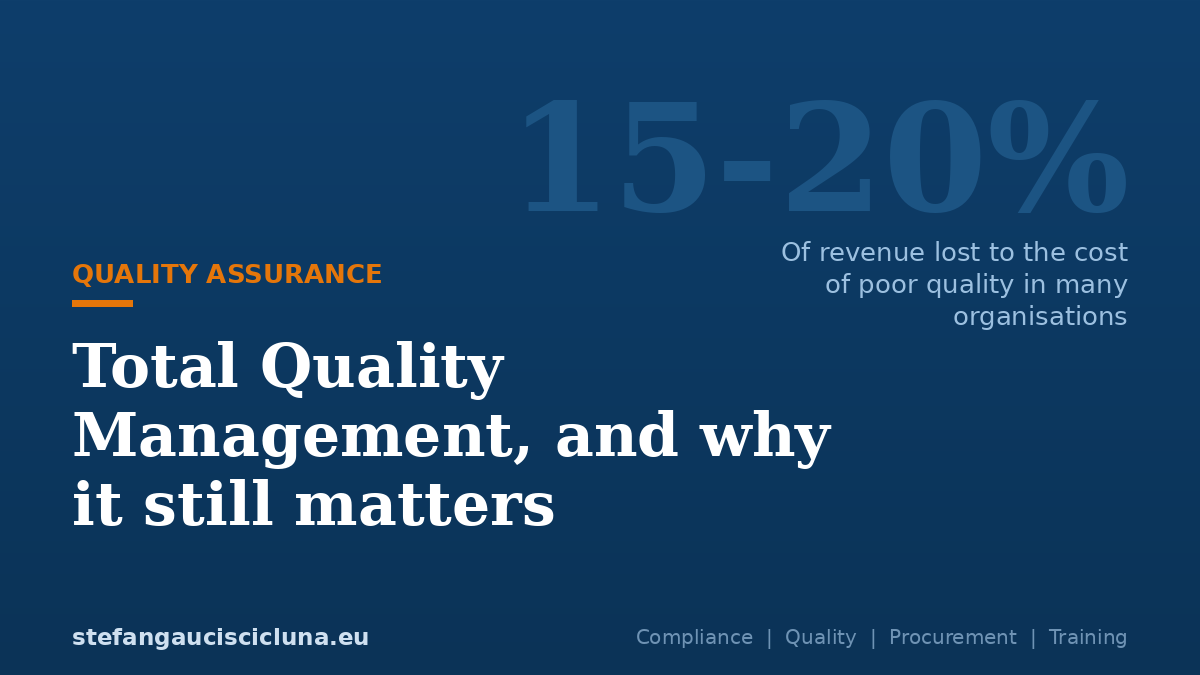
Total Quality Management has an image problem. It sounds like something from a 1980s factory, all wall charts and quality circles, and plenty of people assume it was a fad that passed. It was not. The core idea has quietly become how every well-run organisation operates, whether or not it uses the name. And the problem TQM was built to solve is still costing businesses a fortune: the cost of poor quality, the rework, returns, scrap and lost customers, runs at something like 15 to 20 per cent of revenue in many organisations.1 That is not a rounding error. That is a fifth of the top line, spent fixing things that should not have broken.
The one idea under all of TQM
Strip away the jargon and TQM rests on a single insight, which the quality pioneers Deming and Juran spent their careers proving: it is far cheaper to build quality in than to inspect it out. Inspection finds the defect after you have paid to make it. Prevention stops you making it. An organisation that pours its money into checking, sorting and reworking is paying for quality at the most expensive possible point, after the fact. An organisation that designs the defect out pays once, up front, and stops paying. That is the whole economic argument, and it is why the failure bar in the chart above is so big for firms that inspect instead of prevent.
Why Japan learned it first, and everyone else caught up
The reason TQM is associated with Japan is a quirk of history: American statisticians like Deming took these ideas to a Japanese manufacturing sector rebuilding after the war and hungry to learn, and Toyota and others turned them into a system that eventually out-competed the West on quality and cost at once. The lesson the West eventually, painfully absorbed was that quality and cost are not a trade-off. Done right, higher quality is cheaper, because you stop paying the failure tax. That is counter-intuitive, and it is the single most valuable thing TQM has to teach a business still treating quality as an expense to be trimmed.
The solution, as a principle map
TQM in five working principles
| Principle | What it means in practice |
|---|---|
| Build in, do not inspect in | Design the defect out, do not sort it out at the end |
| Quality is everyone's job | Not a department at the end of the line, a habit through the whole process |
| Focus on the process | Most defects come from bad processes, not bad people. Fix the process |
| Use data, not opinion | Measure where defects actually come from, do not guess |
| Improve continuously | Small, constant improvement beats occasional big projects |
Why this is not just for factories
The instinct is to file TQM under manufacturing, but the cost of poor quality is everywhere. In a service business it is the rework of a botched order, the refund, the complaint handled twice, the customer who leaves. In professional work it is the report sent back, the error found late, the deadline missed because something was wrong upstream. The principle is identical: the defect is cheaper to prevent than to fix, and it usually comes from the process, not the person. A law firm, a clinic and a software team all pay the poor-quality tax, and all can stop paying it the same way a car maker did.
Questions to find your cost of poor quality
- What does rework, returns, refunds and doing things twice actually cost us a year?
- Are we spending on inspection at the end, or prevention at the source?
- When something goes wrong, do we blame the person or fix the process?
- Do we know where our defects really come from, or are we guessing?
- Are we treating higher quality as a cost, when it might be a saving?
Total Quality Management is not a museum piece. It is the still-correct answer to a problem most businesses are still paying for: quality is cheaper to build in than to inspect out, it is everyone's job, and it comes from good processes rather than heroic people. Name the failure tax you are paying, move the money from inspection to prevention, and fix processes rather than blame people. The wall charts have gone out of fashion. The economics never did.
Notes and sources
From the book
Key Quality ModelsFifty models and standards of quality assurance, each explained in plain language and told through a real, sourced case.