
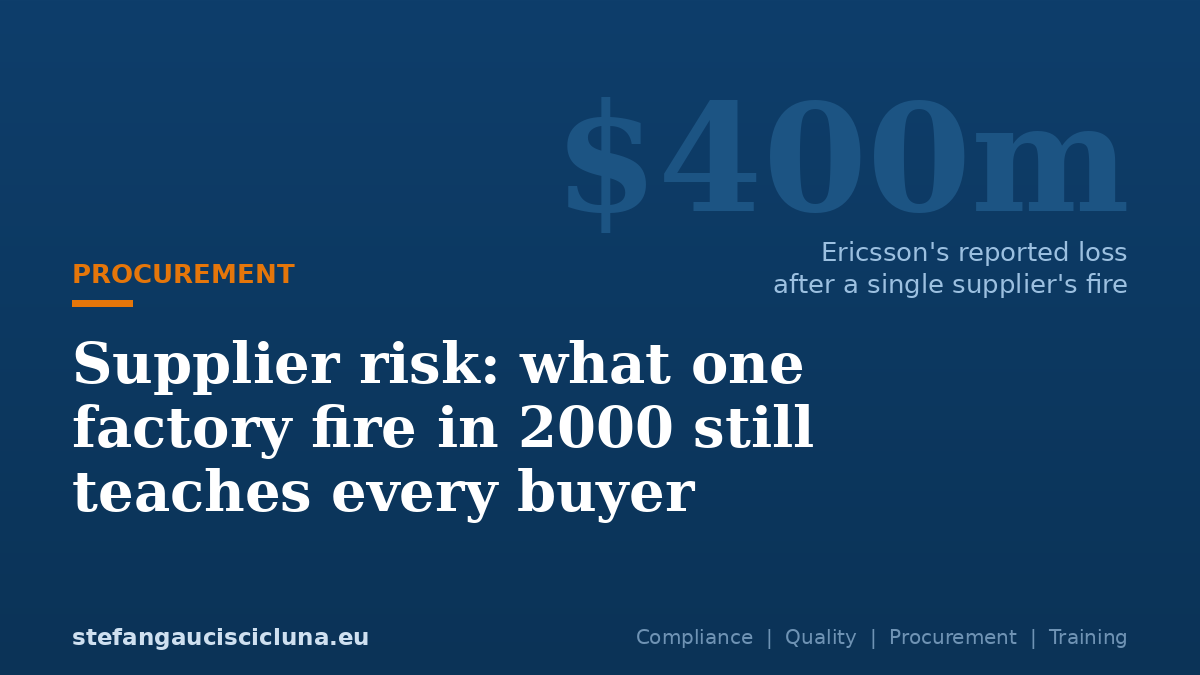
In March 2000, lightning started a small fire at a Philips semiconductor plant in Albuquerque, New Mexico. Sprinklers and staff had it out in minutes. The physical damage looked minor. But that plant made radio-frequency chips for mobile phones, and two of its biggest customers were Ericsson and Nokia, both buying the same part from the same single site.1 What happened next is the most useful supplier-risk lesson ever handed to buyers, because the two companies got opposite results from an identical event.
Nokia noticed the disruption almost immediately, escalated it, locked up alternative supply and re-engineered parts to use other chips. Ericsson took the supplier's reassurance at face value, waited, and by the time it understood the scale of the problem there was no alternative capacity left to buy. It lost hundreds of millions, reportedly around 400 million dollars of sales, and within a year it had effectively exited the handset business.2 One fire, two suppliers' customers, two futures.
The lesson is not "never single-source"
The easy takeaway is to blame single sourcing, and there is truth in it, but it misses the sharper point. Nokia and Ericsson were both single-sourced on that chip. The difference was not the number of suppliers. It was that Nokia had visibility and a plan, and Ericsson had a purchase order and faith. Nokia treated the supply of a critical part as a risk to be actively managed. Ericsson treated it as a line in a spreadsheet that would take care of itself. The fire just revealed which was which.
You cannot protect everything, so tier it
The practical response is not to dual-source everything, which is expensive and often pointless. It is to know which of your suppliers could actually stop your business, and manage those few differently from the many. Most buyers have never drawn this line. They watch price across all suppliers and risk across none, which is exactly backwards for the handful that matter.
The solution, as a risk-tiering method
Sort suppliers by what their failure would cost you
- List every supplier and ask one question: if they stopped tomorrow, what happens to us?
- Tier them. Critical means they can halt your revenue. Important means real pain. Routine means annoyance.
- For the critical few, map the real exposure: single site, single source, long lead time, hard to switch.
- Build a plan per critical supplier before you need it: an alternative, a buffer, a re-design path, or an agreed escalation.
- Rehearse the phone call. Who do you ring, and what do you ask, in the first hour of a disruption?
The whole game is in tier one. If you have three suppliers who could genuinely stop your business and you have no plan for any of them, you are Ericsson in February 2000, and you just have not had your fire yet. The cost of building a plan for those few is small. The cost of not having one, as one Swedish phone maker learned, can be the whole business.
Questions to ask about your critical suppliers
- Which suppliers could actually stop us, not just inconvenience us?
- For each, are we single-site or single-source without knowing it?
- How would we even find out they were in trouble, and how fast?
- What is our plan B, and have we ever tested that it works?
- Are we watching price on everyone and risk on no one?
Supplier risk is not about paranoia or holding twice the stock. It is about knowing where you are genuinely exposed and having thought about it before the phone rings. Nokia did not have a crystal ball. It had a habit of treating critical supply as a risk rather than a formality, and that habit was worth a market-leading position. Twenty-five years on, the fire has changed but the lesson has not. Know your tier one, plan for it, and never mistake a supplier's reassurance for a plan of your own.
Notes and sources
From the book
Procurement That PerformsTurn supplier spend into growth and performance, using AI where it earns its place, with no procurement team.