Business Insights · Updated October 2026

Key Quality Models: 20 quality models and standards, each explained through a real case.

On this page I explain twenty quality models and standards. They run from PDCA and Deming’s 14 Points to ISO 9001, EFQM and Six Sigma. You can read each one in about a minute. Every one is built on a real company case and ends with a question to ask about your own business. They all come from my book Key Quality Models.

How to use this page

Key Quality Models makes one point throughout. In almost every quality failure in the book, the firm knew the model and did not use it. Boeing held a quality certificate built on ISO 9001, and Cadbury knew how to test for salmonella. Each post below takes one model and shows a real organisation following it, or skipping it.

Read them in any order. If you run an operation, begin with PDCA, the process approach and the cost of quality. If a customer or a tender has asked you for certification, begin with ISO 9001, followed by the seven principles and Annex SL. If you are trying to pick an improvement method, put Six Sigma, Kaizen and re-engineering side by side. They sit far apart and suit different problems.

The figures were checked against published sources in October 2026. The sources are listed under each post. Two things have changed since the book was printed, and the posts reflect both. ISO 9001 was reissued in September 2026. The Baldrige framework was reissued a month earlier.

The 20 models on this page

Pick a card and it takes you to the full post. I add new posts to this page from time to time.

Kaizen: Small, constant improvement by the people who do the work

No. 05

Kaizen

Small, constant improvement by the people who do the work

ISO 9001: Say what you do, do what you say, and prove it

No. 07

ISO 9001

Say what you do, do what you say, and prove it

ISO 9004: Managing for sustained success, not just a good year

No. 11

ISO 9004

Managing for sustained success, not just a good year

The EFQM Model: Direction, Execution, Results: great, not just compliant

No. 13

The EFQM Model

Direction, Execution, Results: great, not just compliant

The posts in full

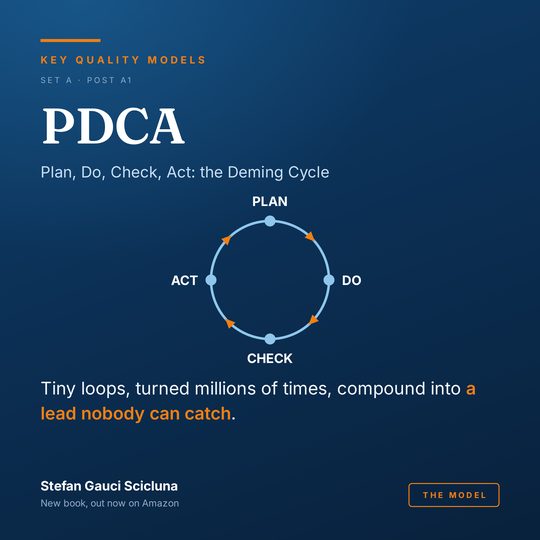
PDCA, the Deming Cycle: Plan, Do, Check, Act: the Deming Cycle. Illustrated card from Key Quality Models.

Key Quality Models · No. 01

PDCA, the Deming Cycle

Plan, Do, Check, Act: the Deming Cycle

You can improve almost anything without spending a penny.

When you stop guessing and start running the loop.

Most people change how they work and never check if it helped.

They just move on. Next month, the same problem is back.

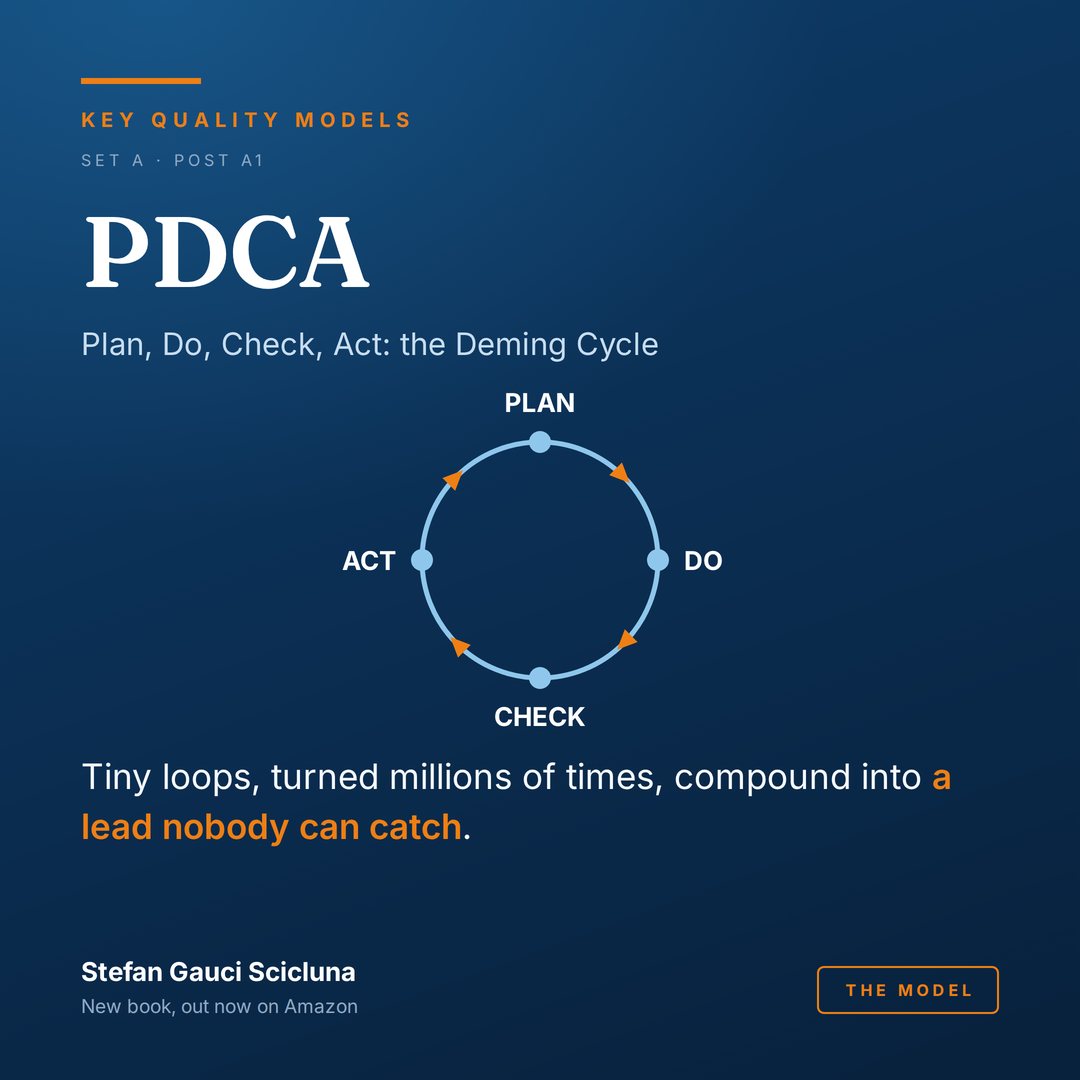
PDCA fixes that. Plan, Do, Check, Act.

Plan: decide the change and predict the result. Do: try it small, one shift, one line. Check: compare what happened to what you predicted. Act: keep it if it worked, drop it if it didn’t. Then turn the wheel again.

The magic is in the “Check”.

You treat every improvement as a prediction you could be wrong about.

That single habit keeps you honest.

Toyota has run its employee suggestion system since 1951. Around 810,000 employee ideas in a single year.

Not 810,000 grand strategies. A machinist moving a bin half a metre. A supervisor shaving 20 seconds off a changeover.

Tiny loops, turned millions of times, compound into a lead nobody can catch.

The lesson for the rest of us is smaller and simpler.

Pick one thing this week. Predict the result before you change it. Check honestly afterwards.

That is the whole discipline. Everything else is decoration.

Sources: Toyota: suggestion system launched in 1951 (75 Years of Toyota); Toyota Times: 810,000 suggestions in 2023.
↑ All 20 models

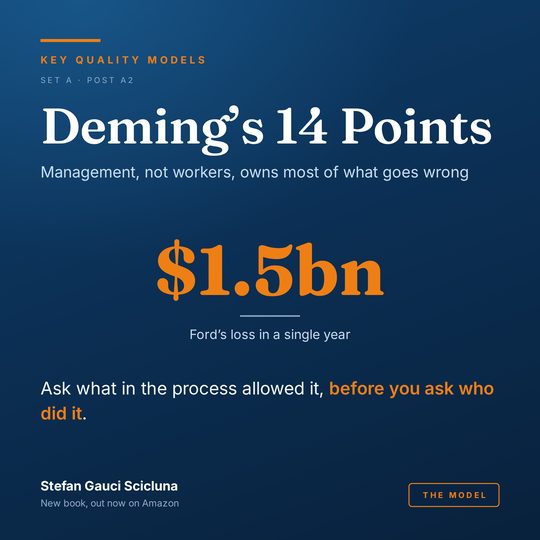
Deming’s 14 Points: Management, not workers, owns most of what goes wrong. Illustrated card from Key Quality Models.

Key Quality Models · No. 02

Deming’s 14 Points

Management, not workers, owns most of what goes wrong

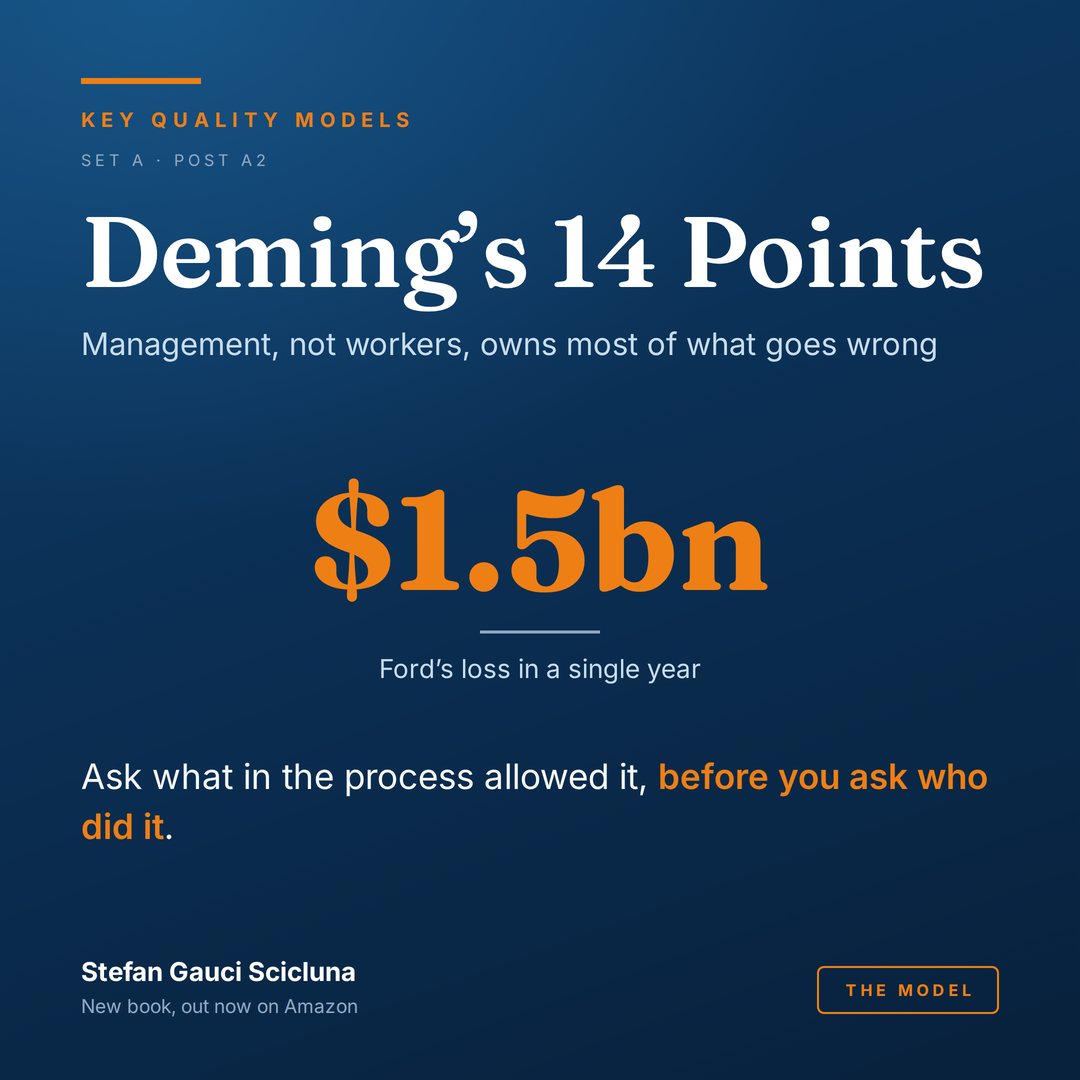
Ford lost 1.5 billion dollars in a single year.

Then it stopped blaming workers and started fixing the system.

In 1980, a documentary put a 79-year-old American statistician on US television. Most executives had never heard of him.

W. Edwards Deming had spent 30 years celebrated in Japan and ignored at home.

Ford called him. His message was blunt: management, not workers, owns most of what goes wrong.

His 14 Points are a manager’s to-do list for building quality in:

Create constancy of purpose. Stop depending on mass inspection. Stop awarding business on price alone. Drive out fear. Break down barriers between departments. Kill the slogans and quotas that pretend willpower fixes a broken system.

Under it sits one idea most leaders resist: most failures are built into the system by management.

So blaming the individual is both unfair and useless.

Ford took it seriously. Fewer suppliers, chosen on capability not lowest price. Engineers and plants actually talking. Quality owned at the top.

The Taurus launched at the end of 1985 and became one of America’s best-selling cars.

From 1986, Ford out-earned General Motors. First time since 1924.

The workers didn’t suddenly try harder. The system changed around them.

Next time something fails, ask what in the process allowed it, before you ask who did it.

Sources: Deming Institute: If Japan Can, Why Can't We? NBC, 1980; Christian Science Monitor: Ford's $1.5 billion loss for 1980; Christian Science Monitor: Ford outearns GM again, 1988.

↑ All 20 models

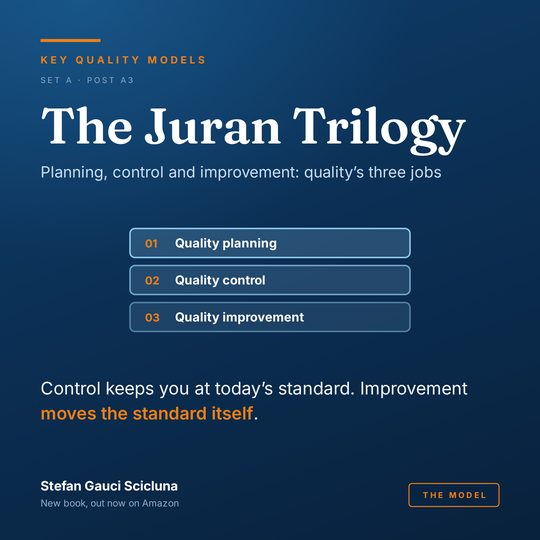
The Juran Trilogy: Planning, control and improvement: quality’s three jobs. Illustrated card from Key Quality Models.

Key Quality Models · No. 03

The Juran Trilogy

Planning, control and improvement: quality’s three jobs

Most companies are drowning in control and starving improvement.

And they can’t tell the difference.

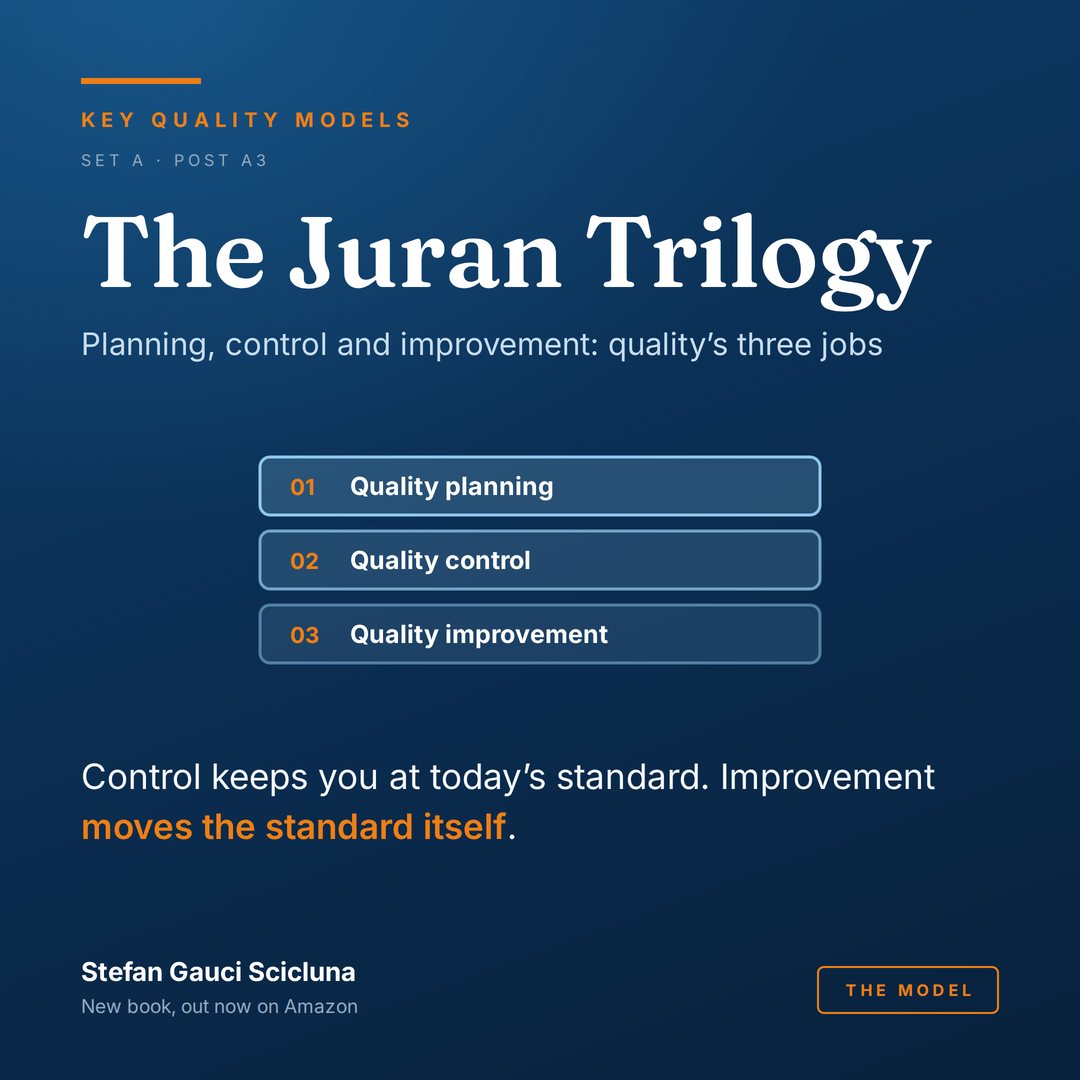
Joseph Juran spent a lifetime consulting on quality, then boiled it down to three jobs. He called it the Trilogy.

Borrow the language of finance and it clicks:

Quality planning is like budgeting. You design the product and process to meet the customer before you run them.

Quality control is like cost control. You watch the process day to day and catch it when it drifts.

Quality improvement is like cost reduction. You deliberately push performance to a level it has never reached.

Here is the sharp bit.

Control keeps you at today’s standard. It fights the fires.

Improvement moves the standard itself.

Most organisations do a mountain of control and almost no improvement, so they stay stuck at a level of waste they have quietly agreed to tolerate.

They call stability “getting better”. It isn’t. It’s staying the same, efficiently.

Try this. Split your quality effort into three piles: planning, control, improvement.

One of them is getting almost nothing. It is nearly always improvement.

Give it a budget and an owner, or it will never happen.

Sources: Juran Institute: the Juran Trilogy explained; J.M. Juran: The Quality Trilogy, 1986 conference paper (PDF).

↑ All 20 models

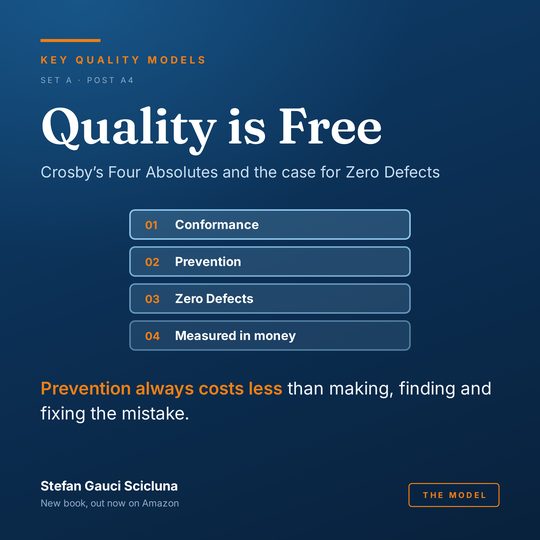
Crosby: Quality is Free: Crosby’s Four Absolutes and the case for Zero Defects. Illustrated card from Key Quality Models.

Key Quality Models · No. 04

Crosby: Quality is Free

Crosby’s Four Absolutes and the case for Zero Defects

“That’s just our scrap rate.”

Six words that cost companies a fortune every year.

At the start of the 1960s, the accepted wisdom was that defects were the price of complex work. You inspected at the end and reworked what you caught.

Philip Crosby, running quality on the Pershing missile programme, refused to accept it.

His idea was deliberately provocative: the right number of defects is zero. And people deliver defects partly because they have been taught to expect them.

His Four Absolutes:

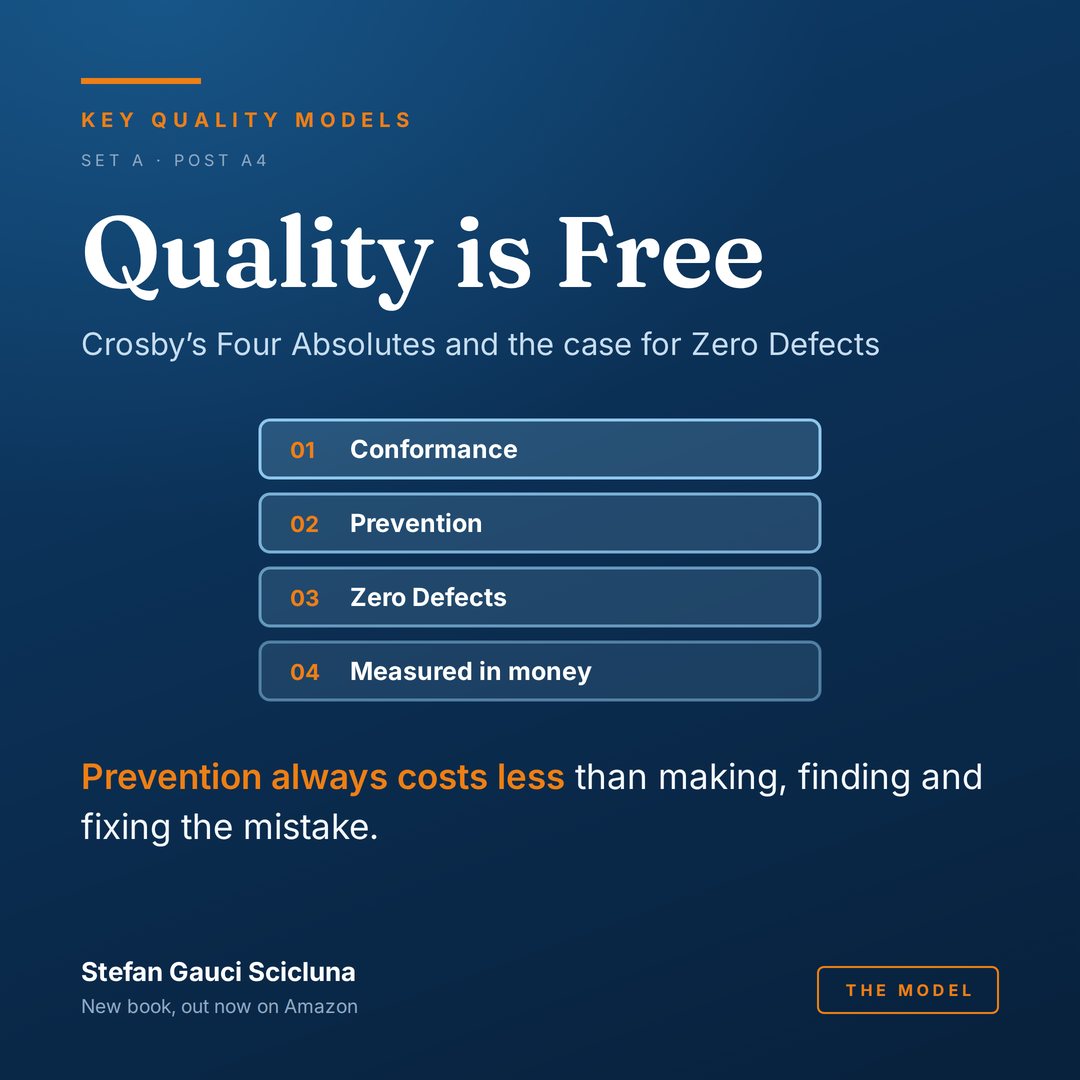
1. Quality means conformance to requirements. Not vague “goodness”. 2. Quality comes from prevention, not inspection. 3. The standard is Zero Defects, not an “acceptable” level that builds failure into the plan. 4. Quality is measured in money: the price of getting it wrong.

Then the line that made him famous: Quality Is Free.

He didn’t mean quality costs nothing. He meant prevention always costs less than making, finding and fixing the mistake. So it pays for itself.

The proof: in 1962 his plant delivered a Pershing system a month early, with no discrepancies in hardware or documentation, operating within a day of setup.

A slogan turned into a delivered missile.

Here is the uncomfortable question. Where has your organisation quietly agreed on an “acceptable” level of failure that no customer would ever accept?

Find it. Name it. That’s where the money is hiding.

Sources: Lockheed Martin: Zero Defects and Crosby on the Pershing programme; ASQ: Philip Crosby, Zero Defects and Quality Is Free; Wikipedia: Zero Defects, the 1962 Pershing delivery.

↑ All 20 models

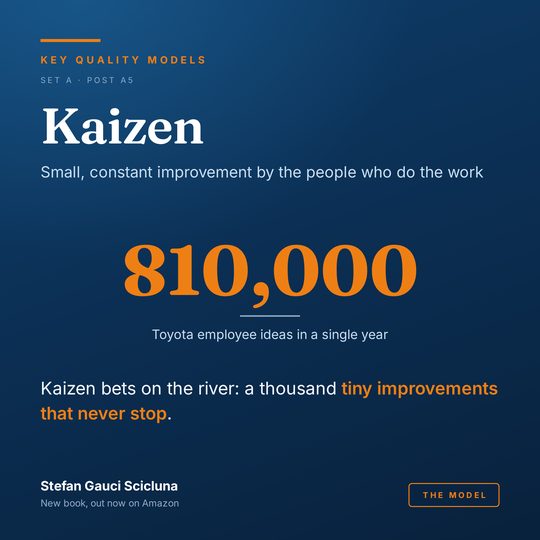
Kaizen: Small, constant improvement by the people who do the work. Illustrated card from Key Quality Models.

Key Quality Models · No. 05

Kaizen

Small, constant improvement by the people who do the work

1% better every day makes you about 37 times better in a year.

But that’s not really why Kaizen works.

Kaizen is a Japanese word: change for the better. Toyota lives it better than anyone.

Not a handful of engineers redesigning the factory. Tens of thousands of ordinary workers improving their own small corner, over and over.

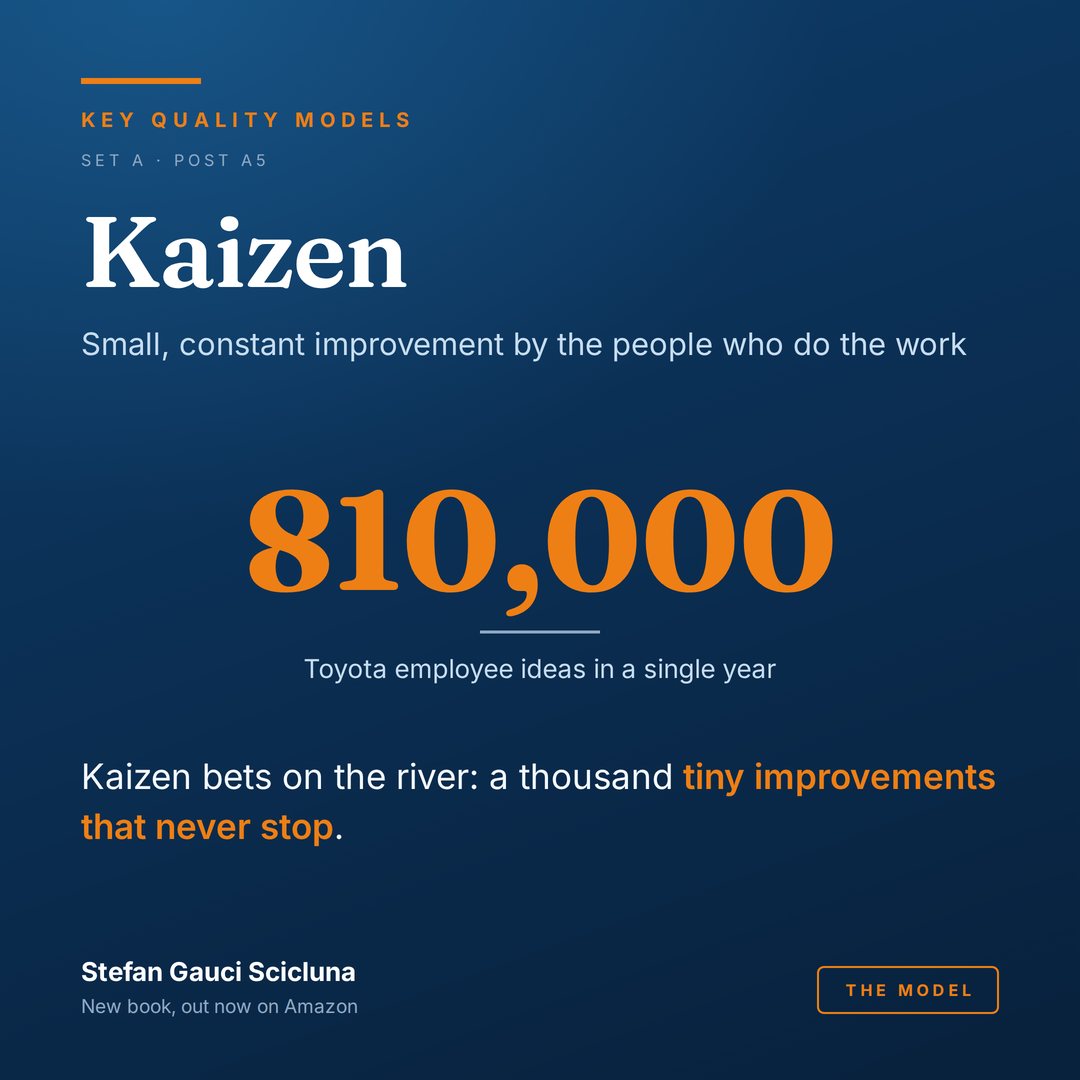
Close to 50 million ideas over the life of the programme. Around 810,000 in a single year.

No single idea would ever make a headline. That is the entire point.

Four beliefs sit underneath it:

Improvement is small and constant, not rare and dramatic. The people who do the work are the ones who improve it, because they see the waste managers can’t. You can’t improve a process that isn’t first stable and documented. It costs almost nothing, because it runs on ideas, not capital.

The West bets on the occasional flood: one big project, one big investment.

Kaizen bets on the river: a thousand tiny improvements that never stop.

Over ten years, the river wins.

One honest question for your business: how easy is it, really, for your most junior employee to suggest and try a small improvement this week?

If the answer is “hard”, that’s your first improvement.

Sources: Toyota Times: 50 million suggestions, 810,000 in 2023; Toyota UK Magazine: what kaizen means and how Toyota uses it.

Longer read: Kaizen: small changes, compounding returns

↑ All 20 models

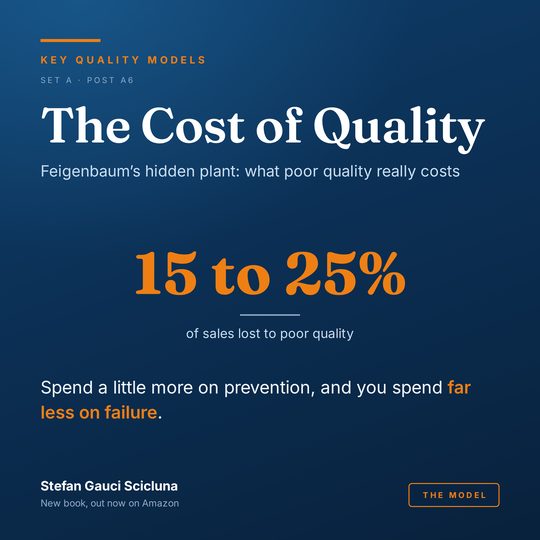
The Cost of Quality: Feigenbaum’s hidden plant: what poor quality really costs. Illustrated card from Key Quality Models.

Key Quality Models · No. 06

The Cost of Quality

Feigenbaum’s hidden plant: what poor quality really costs

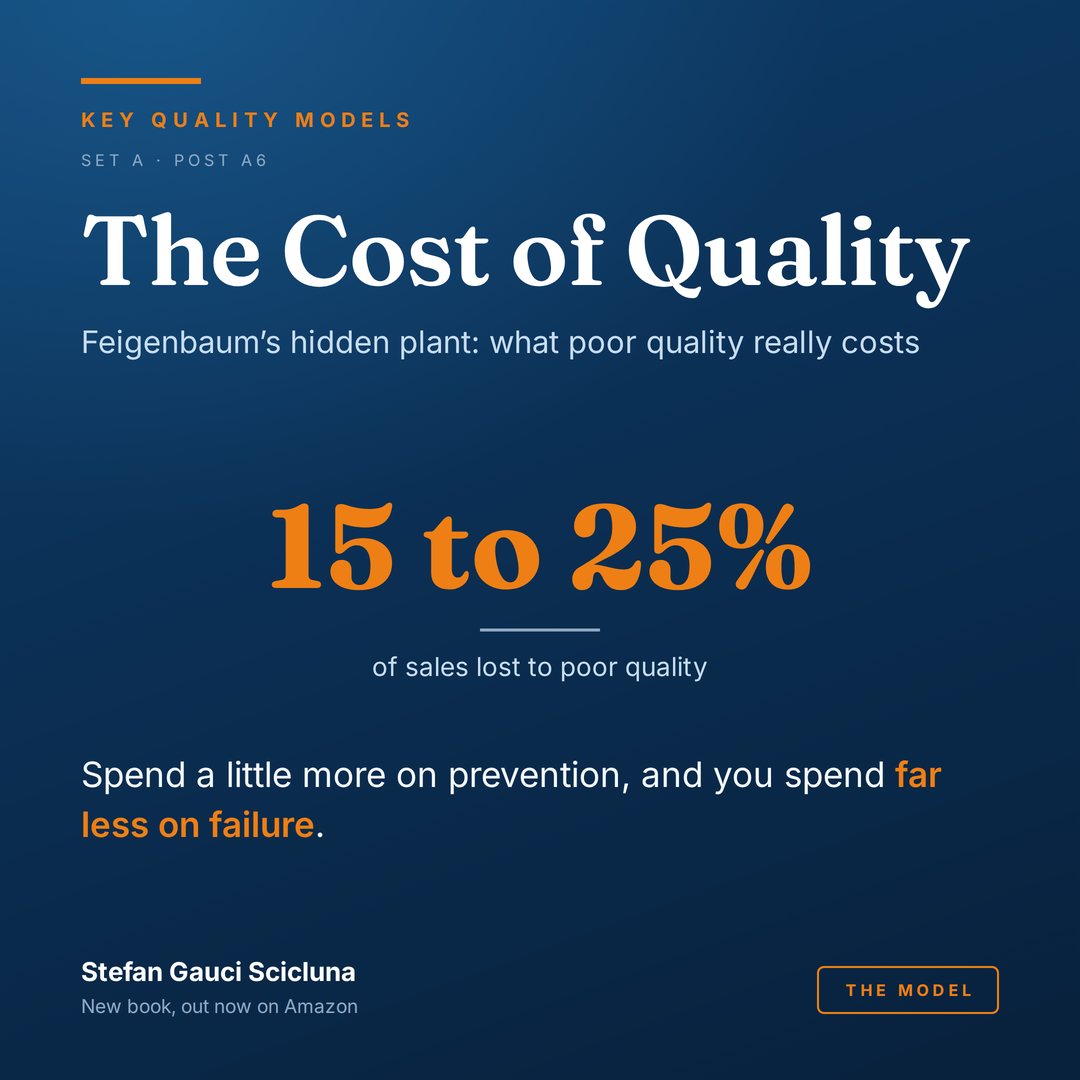
In many companies, poor quality is estimated to cost 15 to 25% of sales.

And almost nobody has ever seen the number.

Armand Feigenbaum spotted it at General Electric in the 1950s. The cost of quality isn’t what the quality department spends.

It’s hidden all over the business.

In scrap bins. On rework benches. In warranty claims. In the inspectors you hired to catch mistakes. In the capacity quietly consumed making things you have to make again.

He called it the hidden plant: a slice of every factory that exists only to redo work done wrong the first time.

He sorted it into four buckets:

Prevention: money spent to stop problems (training, better design, mistake-proofing). Appraisal: money spent checking (inspection, testing, audits). Internal failure: scrap and rework before it ships. External failure: warranty, returns, recalls, lost customers. This one hurts most.

Here is the insight that changes behaviour.

Spend a little more on prevention, and you spend far less on failure. The total falls.

That’s what Crosby meant by “quality is free”. Prevention pays for itself out of the failure it stops.

Ask your finance team one question: what was our cost of poor quality last year?

If the room goes quiet, that silence is expensive.

Sources: ASQ: cost of quality and its four categories; IndustryWeek: Feigenbaum on the hidden factory, 1994.

↑ All 20 models

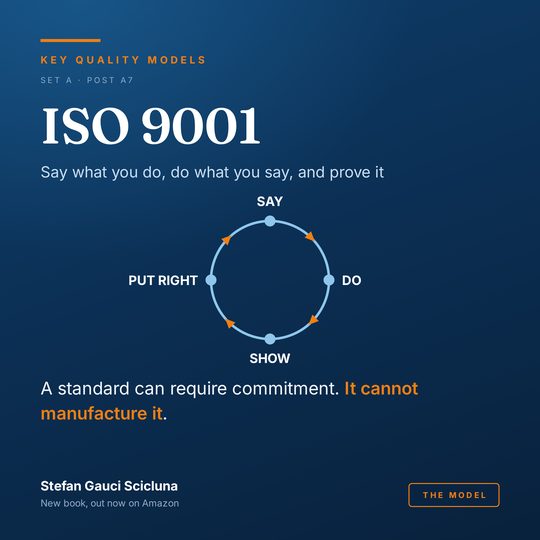
ISO 9001: Say what you do, do what you say, and prove it. Illustrated card from Key Quality Models.

Key Quality Models · No. 07

ISO 9001

Say what you do, do what you say, and prove it

A Boeing 737 lost a door plug at altitude in January 2024.

Four bolts meant to hold it in place were simply not there when it left the factory.

Not loose. Missing.

A great aerospace company, tens of thousands of skilled people, and a hole in the process wide enough to lose four bolts through.

ISO 9001 exists for exactly this.

It doesn’t tell you how to build an aircraft, a sandwich or a mortgage. It tells you how to run the system that decides whether the thing you build is fit for the customer, every time, and how to prove it.

Four lines hold the whole standard:

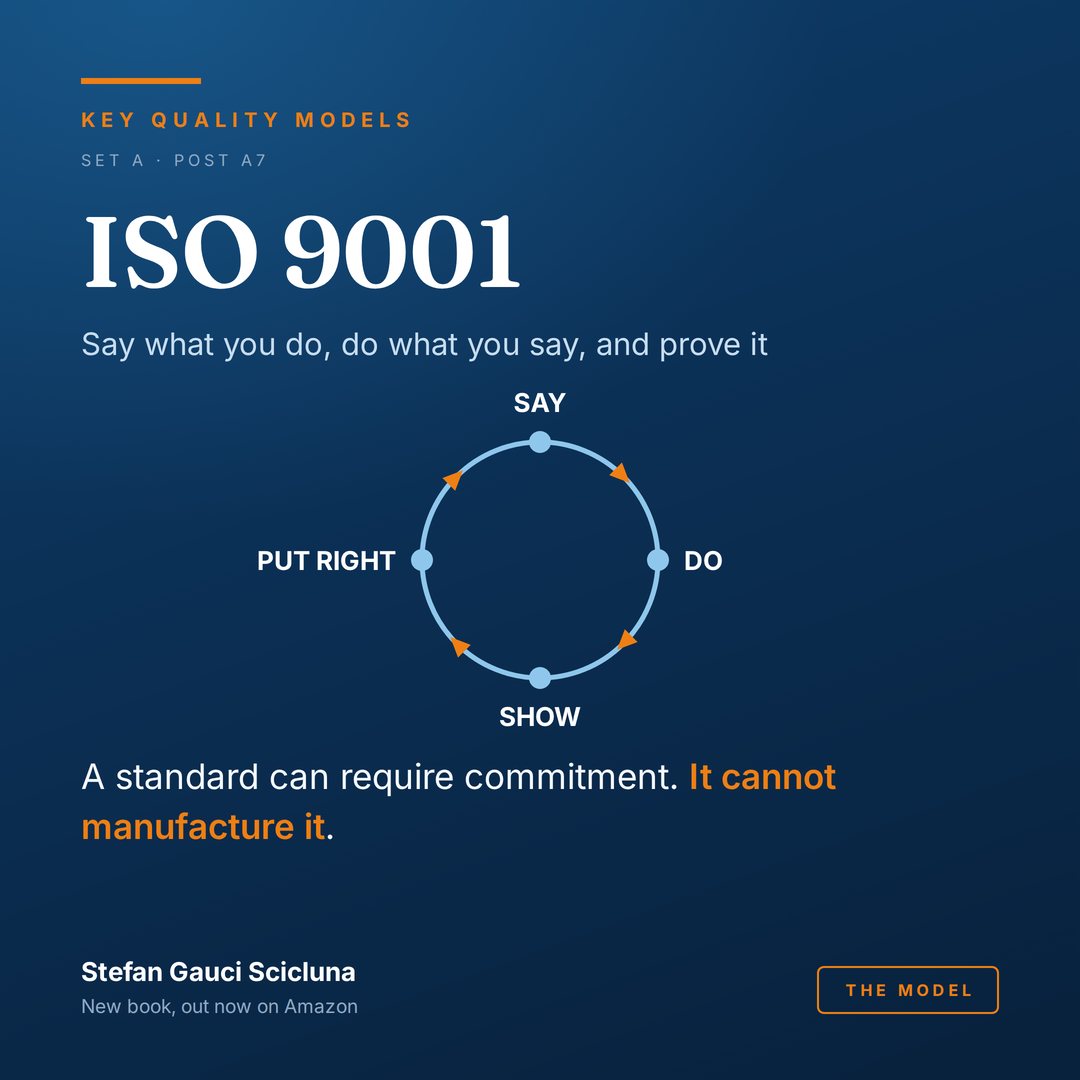
Say what you do. Do what you say. Show the evidence. Put right what goes wrong, so it stays put right.

When the FAA audited the MAX line, Boeing passed 56 product audits and failed 33. At its fuselage supplier, Spirit AeroSystems, auditors found mechanics checking a door seal with a hotel key card and using liquid soap as a lubricant.

These weren’t exotic engineering failures. They were the everyday signs of a system that had stopped being followed.

And here’s the part every leader should sit with: Boeing was a certified company while all this was happening.

A standard can require commitment. It cannot manufacture it.

A system you don’t live is worse than no system at all. It gives you false comfort and a paper trail that lies.

Pick one process you rely on. Could a new starter run it from your written system alone, or does it live in someone’s head?

Sources: NTSB: door plug findings, four bolts missing, June 2025; Popular Science: FAA audit, Boeing failed 33 of 89 checks, 2024; Quality Magazine: ISO certification needs to change, 2024.

Longer read: ISO 9001 that improves the business, not just passes the audit

↑ All 20 models

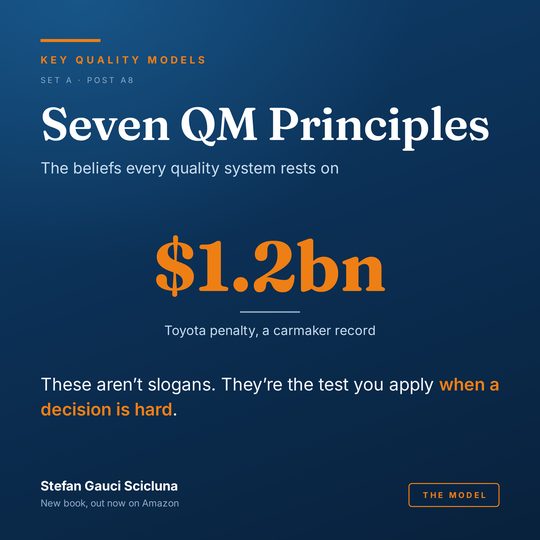
The seven quality management principles: The beliefs every quality system rests on. Illustrated card from Key Quality Models.

Key Quality Models · No. 08

The seven quality management principles

The beliefs every quality system rests on

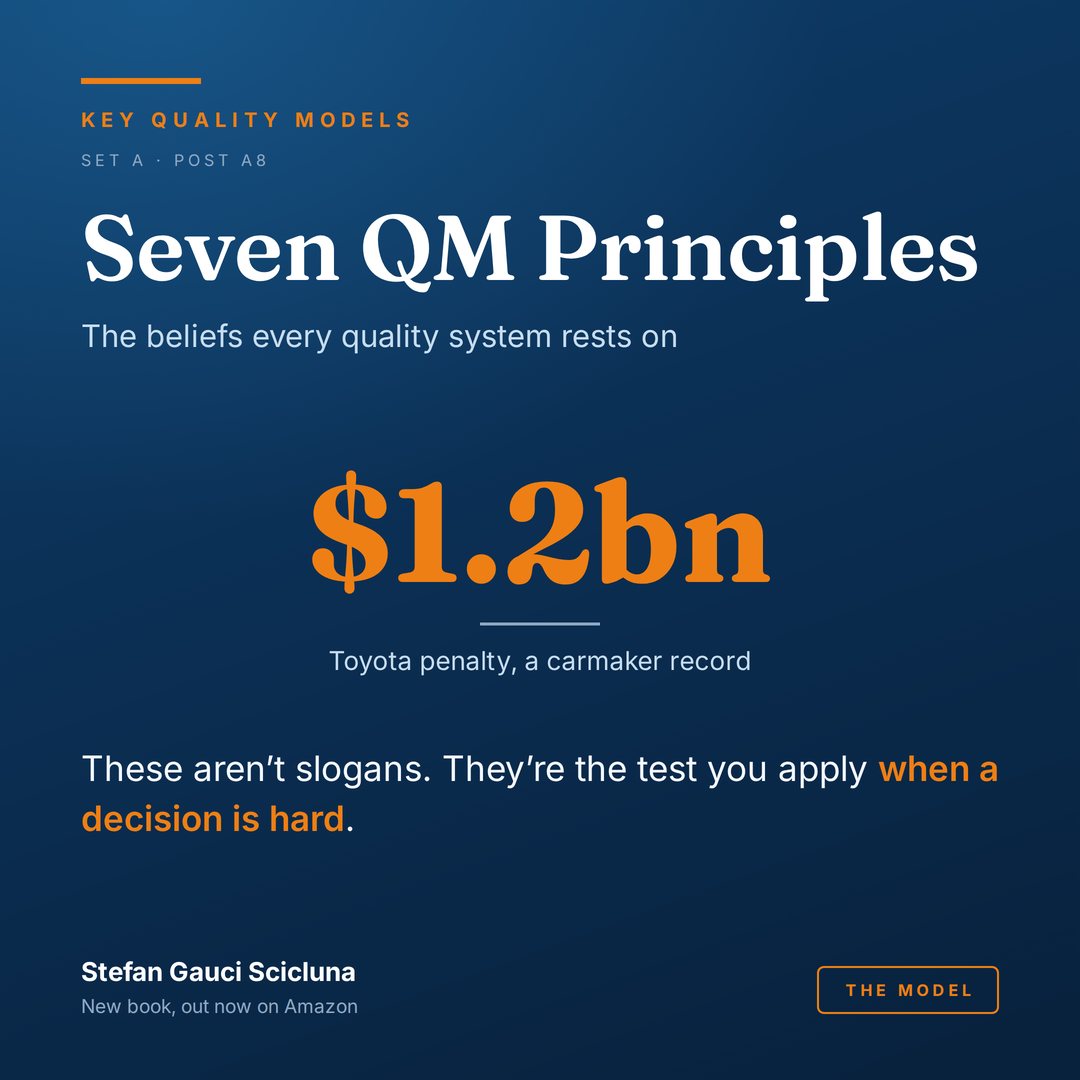
The company that taught the world about quality once stopped listening to its own customers.

By late 2009, Toyota was recalling millions of cars for unintended acceleration.

It had seen the sticky-pedal fault in Europe in 2008 and in US cars by August 2009 and, according to the US Department of Justice, hid it from the regulator and avoided writing it down.

Before you can run any quality system well, you need the beliefs it rests on. ISO names seven:

Customer focus. Leadership. Engagement of people. Process approach. Improvement. Evidence-based decision making. Relationship management.

These aren’t slogans. They’re the test you apply when a decision is hard and the numbers are ugly: which principle am I about to break, and who will pay for it?

And they hang together. Weaken one and the others sag.

Silence your people and evidence stops reaching the top. Ignore your suppliers and your process has a hole you can’t see.

Read Toyota’s crisis through the seven and it lights up. Customer focus and evidence-based decisions slipped when safety reports were treated as a PR problem, not data.

The bill came to a 1.2 billion dollar penalty, then the largest ever imposed on a carmaker.

The recovery was a return to the principles Toyota had written the book on.

Of the seven, which does your leadership team quote most and practise least?

That gap is where your next crisis is forming.

Sources: US Department of Justice: Toyota charge and $1.2bn penalty, 2014; ISO: Quality management principles (official publication); ANSI: the seven principles listed in ISO 9000:2026.

↑ All 20 models

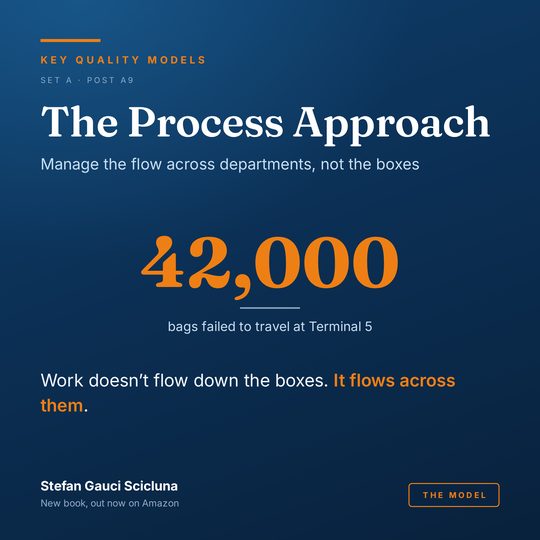
The process approach: Manage the flow across departments, not the boxes. Illustrated card from Key Quality Models.

Key Quality Models · No. 09

The process approach

Manage the flow across departments, not the boxes

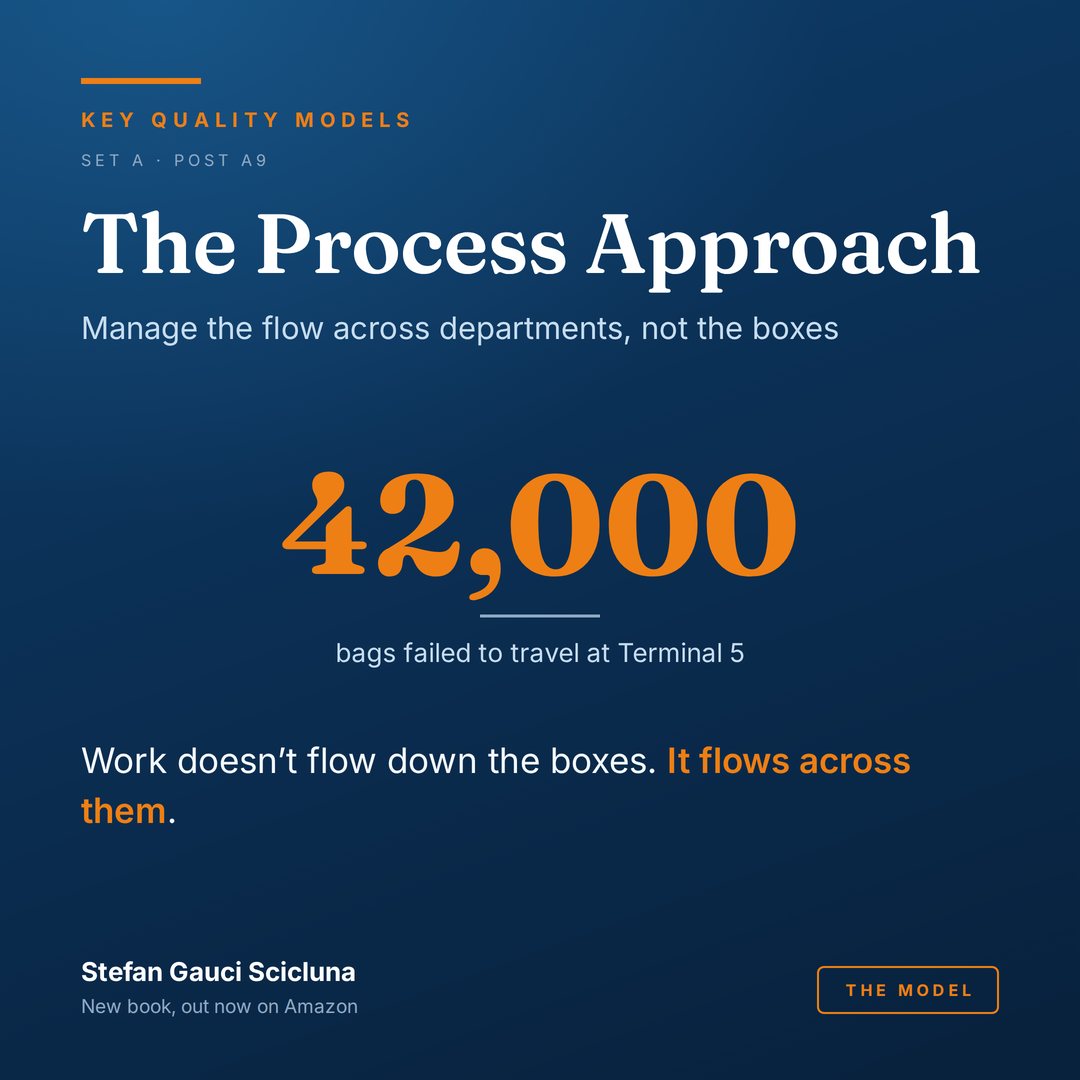
British Airways moved into a 4.3 billion pound terminal.

It descended into chaos within hours.

Terminal 5, March 2008. Staff couldn’t park or clear security to reach their posts. The baggage system jammed.

34 flights cancelled on day one. Over 500 in the following ten days. Around 42,000 bags failed to travel with their owners.

Every single part had been built well.

What failed was the way the parts joined up.

Most organisations are drawn as boxes: departments, functions, silos. But work doesn’t flow down the boxes. It flows across them.

The process approach says: manage the horizontal flow.

Define your processes as chains that turn an input into something a customer values. Name one owner for the whole chain. Agree the handovers. Measure the flow, not just each department’s local score.

The trap it guards against: a process run brilliantly inside its silo can still starve the process next door.

Security ran its process. Parking ran its. Baggage ran its. Each may have hit its own target while the passenger, who lives across all three, was failed.

Someone has to own the space between the boxes, because that space belongs to no department, and that’s where most failures live.

Draw one customer outcome as a flow across departments. Where are the handovers, and who owns the whole line?

If the answer is “nobody”, you’ve found your Terminal 5.

Sources: UK Parliament: Transport Committee report on Terminal 5, 2008; The Scotsman: 34 flights cancelled on opening day, 2008.

↑ All 20 models

Risk-based thinking: Ask what could go wrong at every important step. Illustrated card from Key Quality Models.

Key Quality Models · No. 10

Risk-based thinking

Ask what could go wrong at every important step

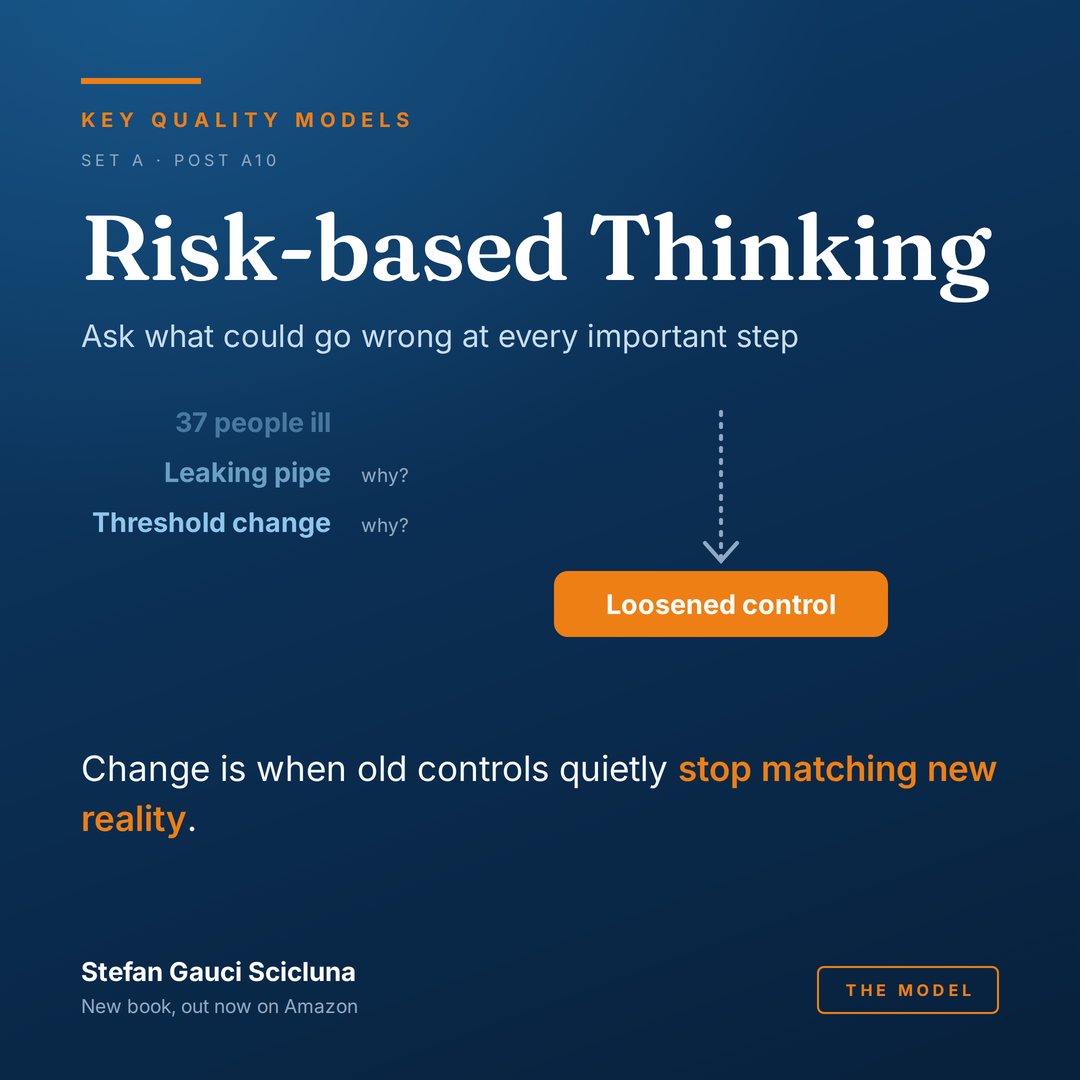
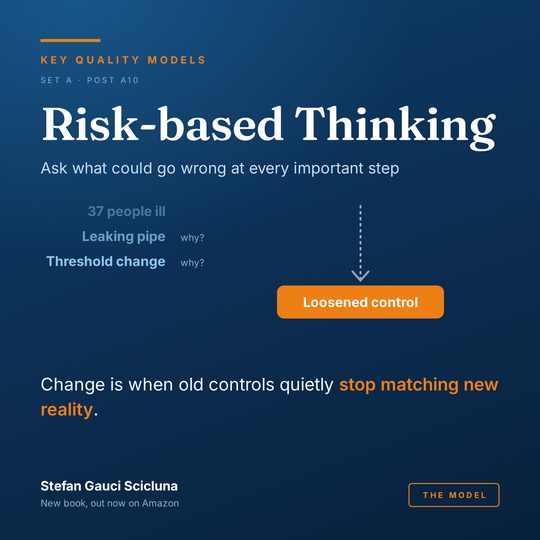
Cadbury changed one test. Three years later, at least 37 people fell ill.

In 2006, a salmonella outbreak was traced to a leaking pipe at a Cadbury plant. Seven products recalled. Around a million items pulled. A one million pound fine.

But the pipe was only the trigger.

The real cause was a change made three years earlier.

Around 2003, Cadbury moved from a zero-tolerance stance, where any salmonella meant the batch was destroyed, to a system that assumed a “safe” threshold below which product could pass.

It later accepted in court that the new method was badly flawed and wrong.

Risk-based thinking asks one question at exactly that moment: if we loosen this control, what new failure becomes possible, and who could it reach?

Nobody asked it loudly enough.

The old quality systems had a “preventive action” clause that almost nobody used well. ISO replaced it with something woven through everything: at every important step, ask what could go wrong, how bad, how likely, and what you’ll do about it.

Its sharpest use is at the moment of change. Change is when old controls quietly stop matching new reality.

Name a control you have relaxed, or plan to relax, because “it’s never been a problem”.

What new failure does that open? And who would it reach?

Ask it now. It’s cheaper than asking it in a recall.

Sources: ConfectioneryNews: Cadbury named as outbreak source, 2006; RTÉ News: Cadbury fined £1m over salmonella outbreak, 2007; Food Manufacture: the 2003 testing change and the judge's view.

↑ All 20 models

ISO 9004: Managing for sustained success, not just a good year. Illustrated card from Key Quality Models.

Key Quality Models · No. 11

ISO 9004

Managing for sustained success, not just a good year

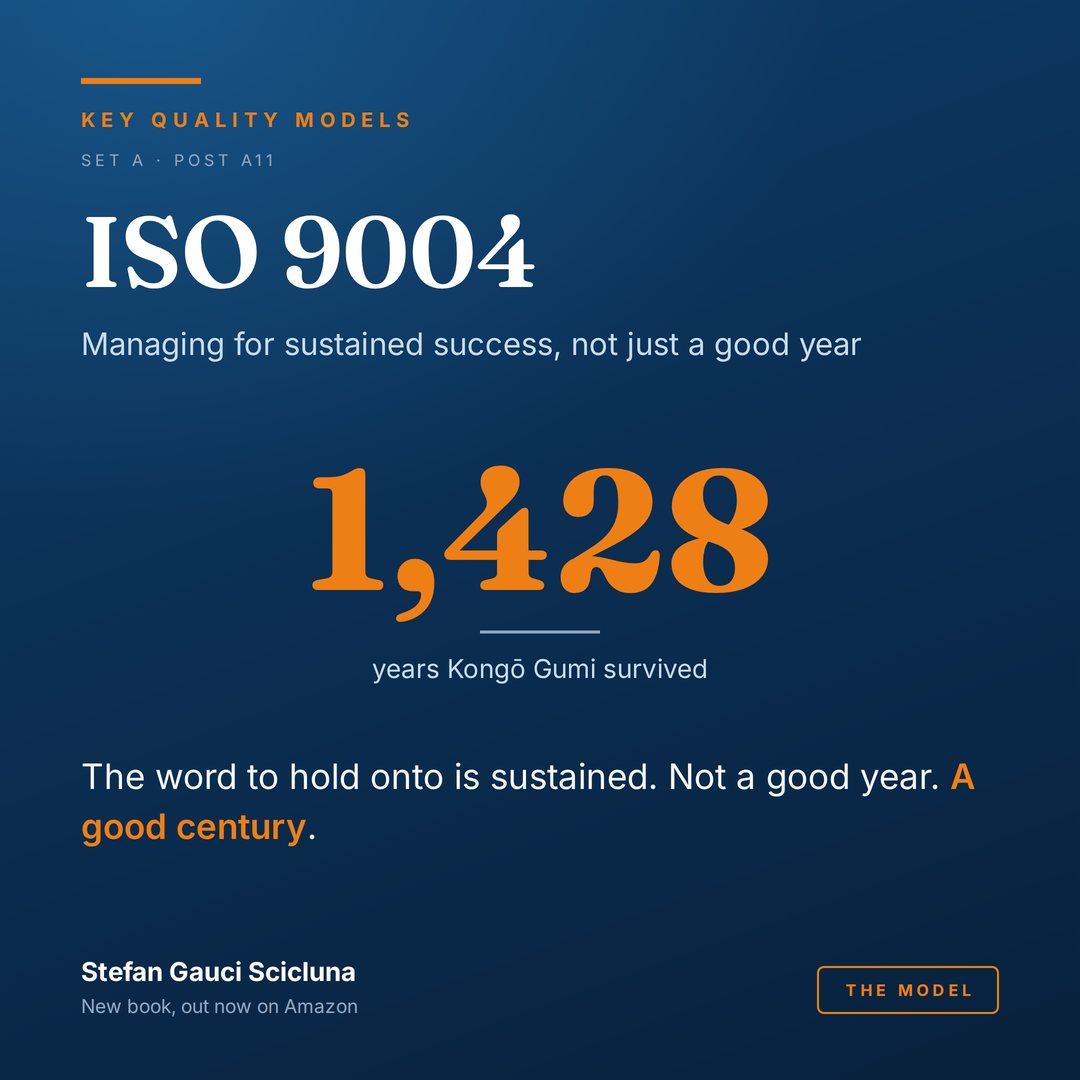
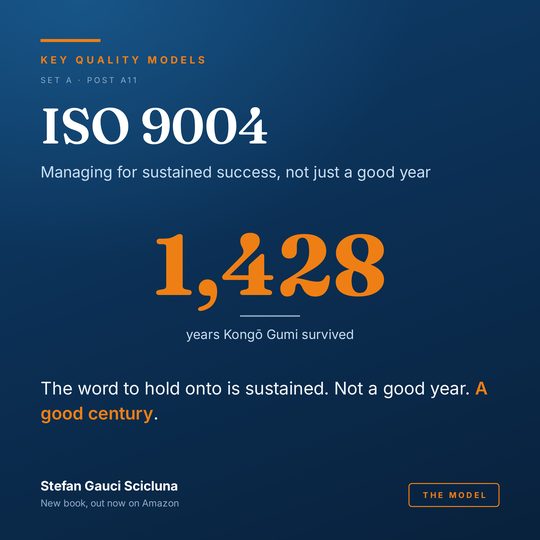
The oldest company on Earth survived 1,428 years.

Then lost its independence in a single generation.

Kongō Gumi was founded in Japan in AD 578 to build a temple. It went on to help build Osaka Castle and restore shrines for more than fourteen centuries, run by the same family across dozens of generations.

Wars. Famines. The arrival of concrete. It survived all of them.

Then, in 2006, it was absorbed into another company.

What ended it wasn’t a bad year. It was borrowing heavily to chase real estate in Japan’s 1980s bubble, far from the temple craft that had carried the family for a thousand years.

When the bubble burst, the debt stayed. Demand for temple work fell. The core was starved to feed the gamble.

ISO 9001 asks: can you meet today’s requirements?

ISO 9004 asks a bigger question: will you still be here, and still good, in twenty or a hundred years?

It widens the lens from the customer to everyone with a stake, and hands you a self-assessment to rate your strategy, leadership, resources and processes honestly.

The word to hold onto is sustained. Not a good year. A good century.

One question for your own business: what are you doing today that borrows against your organisation’s next twenty years?

Sources: ISO: ISO 9004:2018, guidance to achieve sustained success; Long Now Foundation: the end of a 1,400 year old business.

↑ All 20 models

Annex SL, the harmonised structure: One shared skeleton for ISO management system standards. Illustrated card from Key Quality Models.

Key Quality Models · No. 12

Annex SL, the harmonised structure

One shared skeleton for ISO management system standards

Three management systems. Three manuals. Three audits. All saying much the same thing.

For decades, a company certified for quality, environment and safety ran three systems that spoke three different dialects.

Different clause numbers. Different jargon. Different words for the same ideas.

Then a small piece of committee work quietly changed the whole picture.

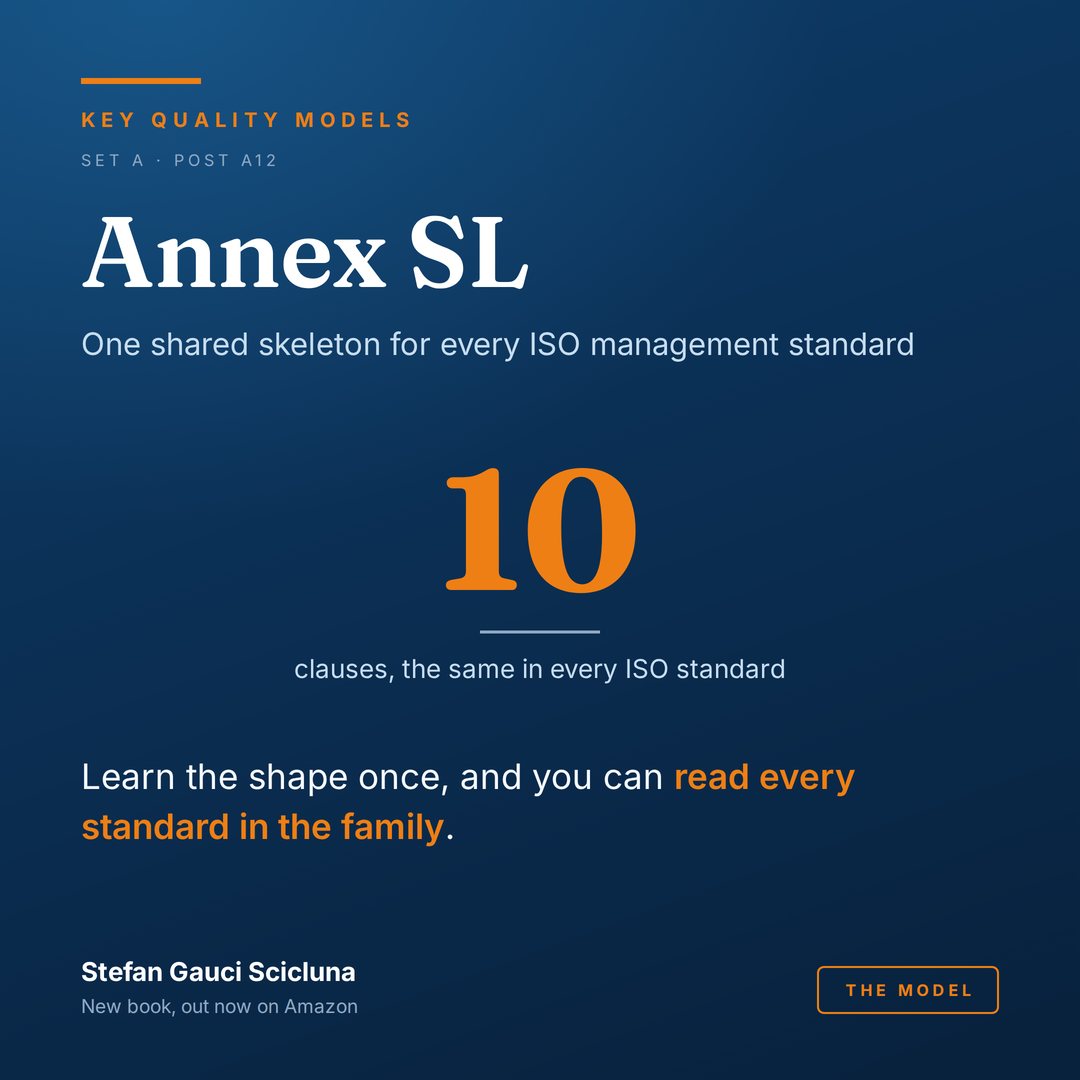
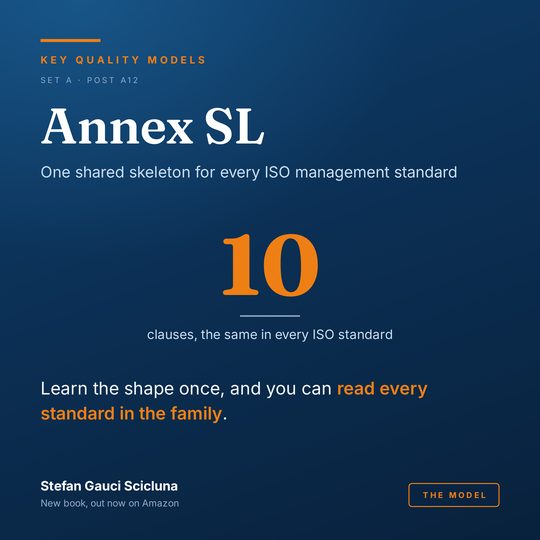
Annex SL is a shared skeleton for almost every ISO management standard. Ten clauses, the same everywhere: context, leadership, planning, support, operation, performance evaluation, improvement, and more.

It’s plumbing, not architecture. And like good plumbing, you only notice it when it’s missing.

Before it, integrating two standards meant a translation job: matching clause 4 of one to a scattered set of clauses in another, arguing over whether “document” and “record” meant the same thing.

After it, the mapping is one to one. Leadership is clause 5 wherever you look. Planning is clause 6.

Learn the shape once, and you can read almost every standard in the family.

When ISO 45001 for health and safety arrived in 2018, companies already certified for quality and environment could bolt it on to the same structure, rather than build a fourth silo.

Three dialects became one language.

How many management systems do you run, and how much of each is really the same clauses written three times?

There’s an integration saving sitting right there.

Sources: IAF: Annex SL underpins nearly all ISO management standards; ANSI: the ten clauses of Annex SL; ISO: ISO 45001 is now published, March 2018.

↑ All 20 models

The EFQM Model: Direction, Execution, Results: great, not just compliant. Illustrated card from Key Quality Models.

Key Quality Models · No. 13

The EFQM Model

Direction, Execution, Results: great, not just compliant

Your ISO audit passed. Complaints are low.

So are you actually a great organisation, or just a compliant one?

Certification tells you that you do what you say. It doesn’t tell you whether what you say is ambitious, whether your people believe in it, or whether your results would stand next to the best in your field.

That gap is where the EFQM Model earns its keep.

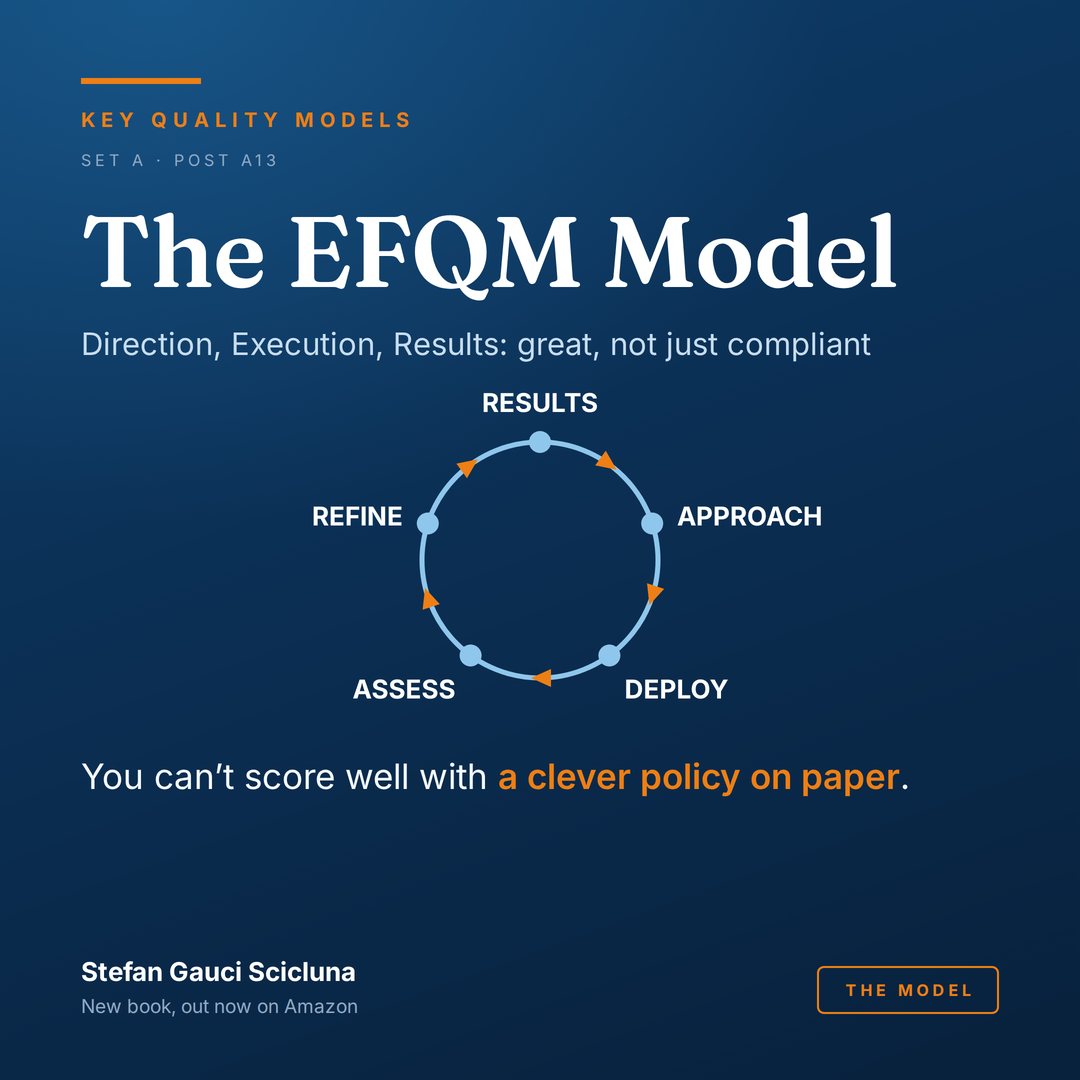
It gives you a single map of an organisation and asks you to assess yourself honestly across all of it, in three blocks:

Direction: why you exist and where you’re going. Purpose, vision, culture, leadership. Execution: how you actually run the place. Results: what you have to show for it.

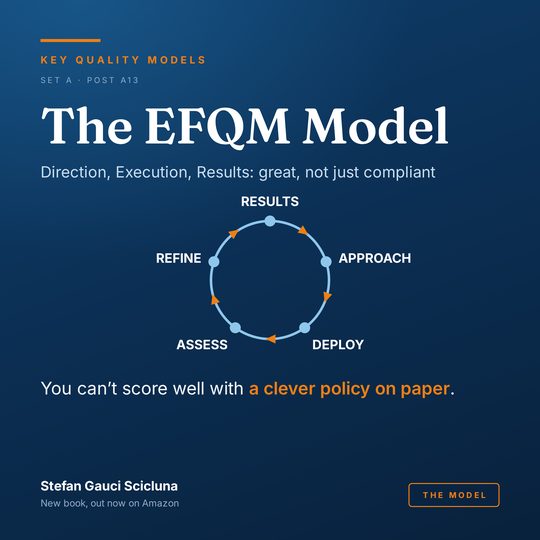
The scoring engine, RADAR, is the part practitioners quietly love. For every approach you claim, it asks: what Results were you targeting, what Approach did you choose, how far did you Deploy it, and how do you Assess and Refine it?

You can’t score well with a clever policy on paper.

You score well by showing the policy is everywhere, is measured, and gets better each cycle.

GC Europe, a dental materials maker, built its management on this model and in 2019 became the first dental company to win the EFQM Global Excellence Award.

A specialist manufacturer used a general excellence model to keep raising a bar that certification alone would never have moved.

If you scored your own organisation on Direction, Execution and Results today, which block would embarrass you most?

Start there.

Sources: EFQM: the EFQM Model (Direction, Execution, Results); GC Europe: EFQM Global Excellence Award winner, 2019.

Longer read: EFQM and business excellence models: measuring what good actually looks like

↑ All 20 models

The Baldrige Excellence Framework: Linked categories, proved with data, not stories. Illustrated card from Key Quality Models.

Key Quality Models · No. 14

The Baldrige Excellence Framework

Linked categories, proved with data, not stories

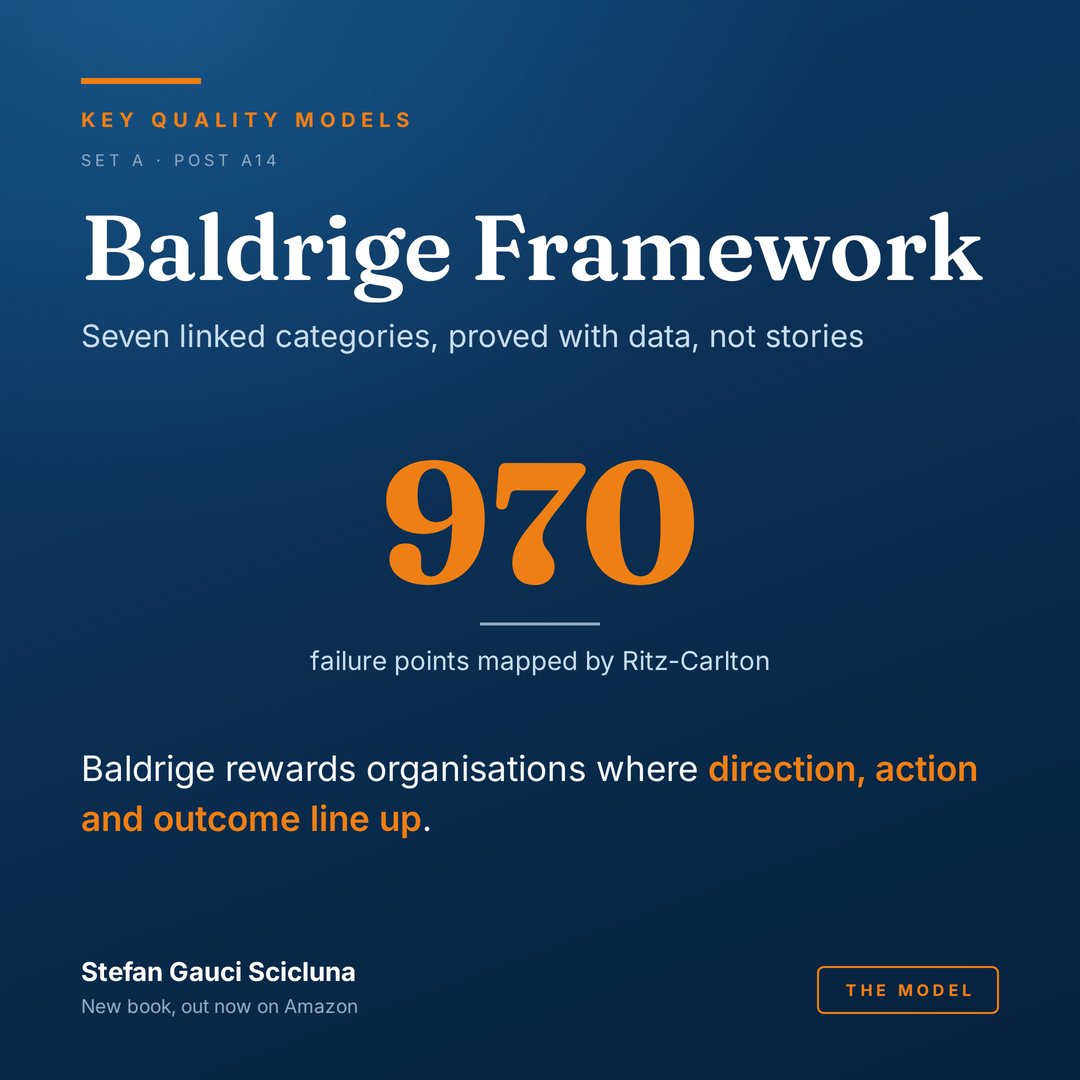
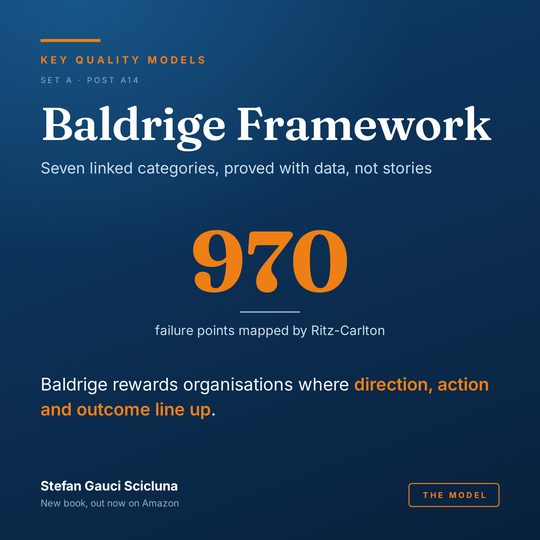
The Ritz-Carlton mapped 970 points where a guest interaction could go wrong.

Then worked to design each one out.

America created a national quality award in 1987, named after Malcolm Baldrige. The point wasn’t to hand out prizes. It was to define what a world-class organisation looks like, publish it, and let every company measure itself against it.

For decades the framework examined you through seven linked categories: Leadership, Strategy, Customers, Measurement, Workforce, Operations, and Results, which carried the most weight. The 2026 edition keeps six and builds results into every one.

The logic tying it together is a demand for alignment.

A strong leadership statement that never reaches the workforce scores badly. A clever strategy with no results behind it scores badly.

Baldrige rewards organisations where direction, action and outcome line up and reinforce each other. And it makes you prove it with data, not stories.

The Ritz-Carlton is the only two-time winner in the service category. The reported numbers show why:

Around 99% of guests satisfied. Return on investment up from 5.3% to 9.8% in three years. First-year staff getting 250 to 310 hours of training. Staff turnover falling nine years running.

Leadership, workforce, customers and results, locked together.

In your last board pack, how much space went to results versus activity?

That ratio tells you what your organisation actually rewards.

Sources: NIST: Ritz-Carlton Baldrige Award profile, 1999; NIST: history of the Baldrige programme and the 1987 Act; Baldrige Foundation: key changes in the 2026 framework.

↑ All 20 models

The Deming Prize: Japan’s toughest award for company-wide quality. Illustrated card from Key Quality Models.

Key Quality Models · No. 15

The Deming Prize

Japan’s toughest award for company-wide quality

The most demanding quality award in the world doesn’t reward a good year.

It rewards a company that has changed how it thinks, and can prove it under days of examination.

The Deming Prize was founded in Japan in 1951, using the royalties from Deming’s own lectures.

It’s less a checklist than a judgement about whether total quality management has actually taken root, from the boardroom to the shop floor.

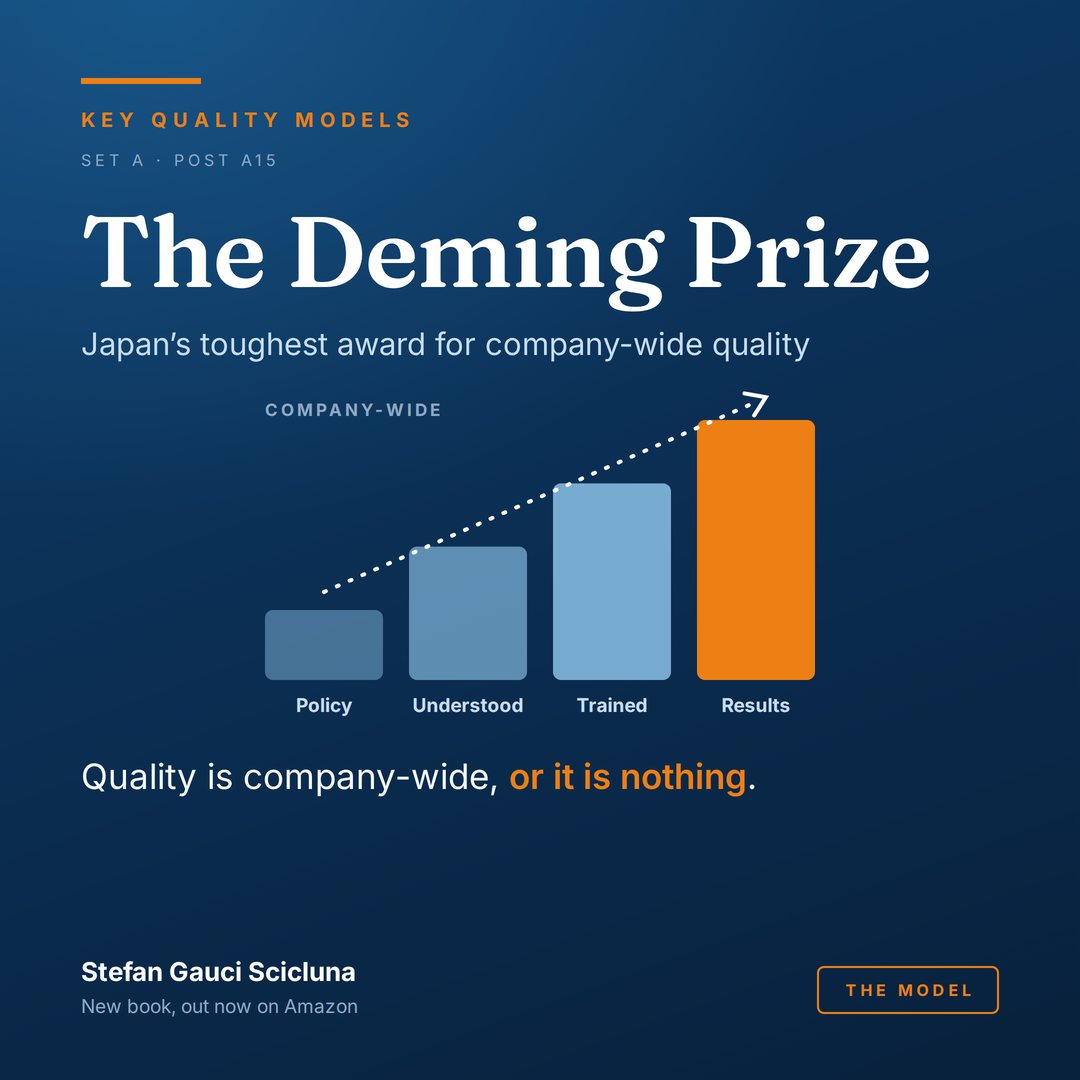
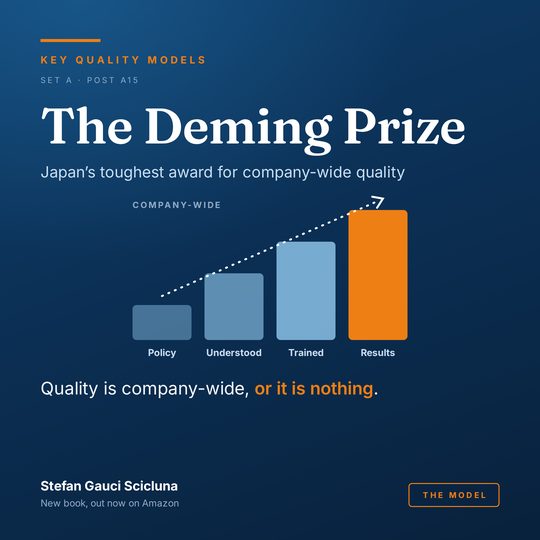
Examiners look at whether leadership drives clear policies, whether those policies are understood everywhere, whether people are trained and involved, and whether results are maintained and improved.

The conviction underneath it: quality is company-wide, or it is nothing.

A brilliant production line inside a company with a weak policy or an untrained workforce will not pass.

Here’s the myth it broke.

For years, people believed this level of quality was cultural, available only to Japanese firms.

Then Sundaram Clayton, an automotive component maker in India, began a serious push in 1989 and in 1998 became the first Indian company, and the fourth outside Japan, to win the prize.

It wasn’t cultural. It was available to anyone willing to do the work for a decade.

One honest question: if an examiner spent three days inside your operation, where would your stated policy and your real behaviour part company?

Everyone has a gap. The strong ones go looking for it first.

Sources: JUSE: how the Deming Prize was established; JUSE: history of the Deming Prize, first awarded 1951; TVS Motor (BSE filing): Sundaram-Clayton's 1998 Deming Prize.

↑ All 20 models

CMMI, the maturity staircase: Levels of process maturity, from heroes to optimising. Illustrated card from Key Quality Models.

Key Quality Models · No. 16

CMMI, the maturity staircase

Levels of process maturity, from heroes to optimising

A talented engineer in an immature organisation still ships late.

Because the system around them is unpredictable.

In the 1980s, the US Department of Defense kept commissioning software that came in late, over budget, and full of defects. It had no way to tell in advance which suppliers to trust.

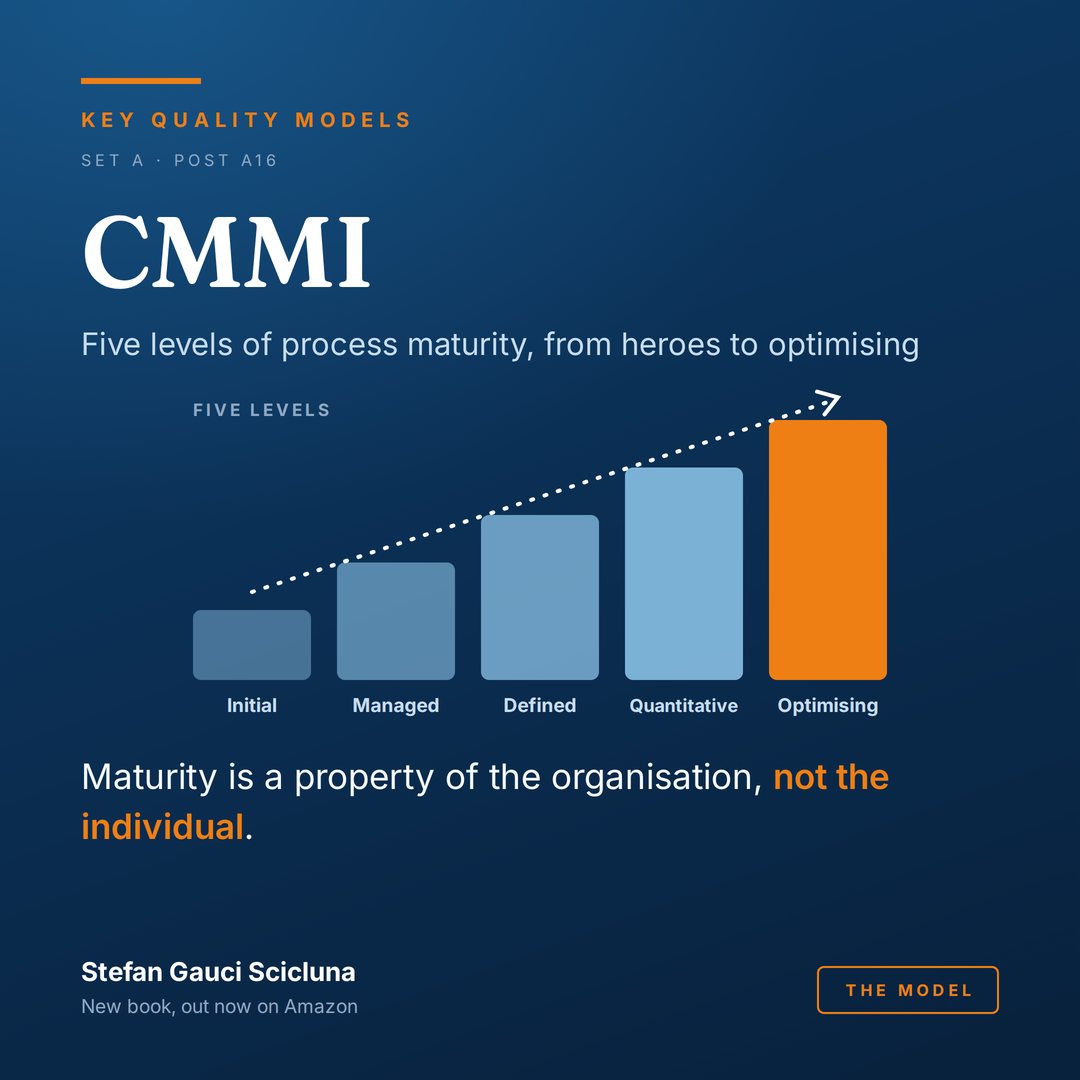
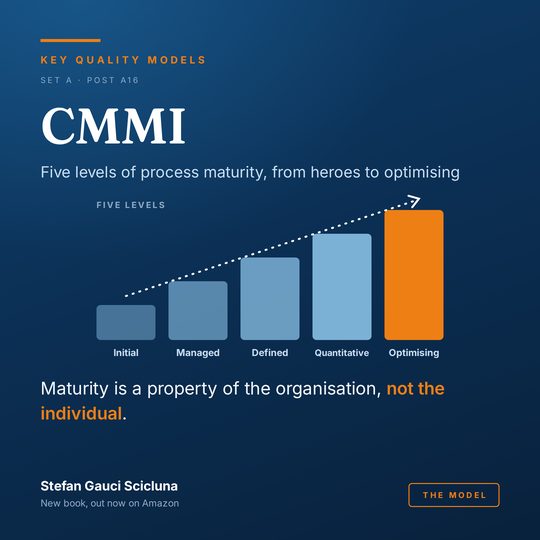
So it asked Carnegie Mellon to build a way to judge process maturity. The result was a staircase, later called CMMI. Five levels, above a starting Level 0:

Level 1, Initial: work gets done, but success depends on heroes and luck. Level 2, Managed: projects are planned and controlled, but every team does it its own way. Level 3, Defined: standard processes, shared rather than reinvented. Level 4, Quantitatively Managed: you control processes with data and understand your own variation. Level 5, Optimising: you continually improve your processes on purpose.

The insight that matters: maturity is a property of the organisation, not the individual.

Wipro, the Indian IT services company, reached Level 5 and tied it directly to business outcomes: a jump in its Net Promoter Score and more than double the automation in fixed-price projects inside a single quarter.

Maturity at that level isn’t paperwork. It’s the ability to change your own delivery deliberately and see the effect.

One question: which of the five levels honestly describes your delivery, and what breaks when your best people are away?

If everything breaks, you’re relying on heroes. Heroes leave.

Sources: CMMI Institute: the maturity levels, 0 to 5; CMMI Institute (ISACA): Wipro Level 5 case study; Carnegie Mellon SEI: how the maturity model began in 1986.

↑ All 20 models

Total Quality Management: Quality built by everyone, in every function, from the start. Illustrated card from Key Quality Models.

Key Quality Models · No. 17

Total Quality Management

Quality built by everyone, in every function, from the start

Japanese competitors were selling copiers for what it cost Xerox to build them.

Xerox was losing market share fast. Then it bet the company on quality.

For a long time, quality was somebody else’s job: an inspector at the end of the line, pulling out the bad ones.

Total Quality Management flips that. Quality is built by everyone, in every function, from the start.

It rests on a handful of commitments that reinforce each other:

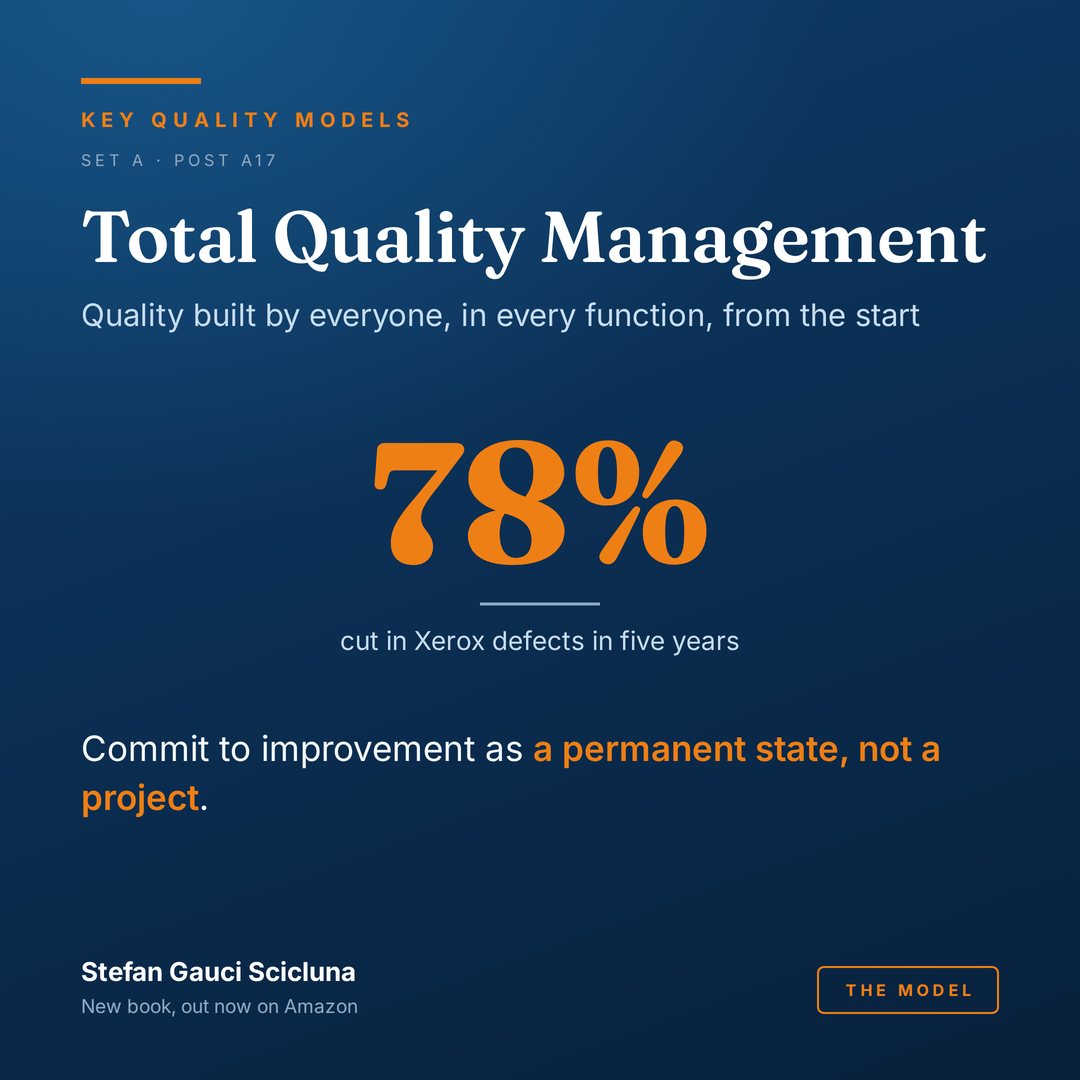
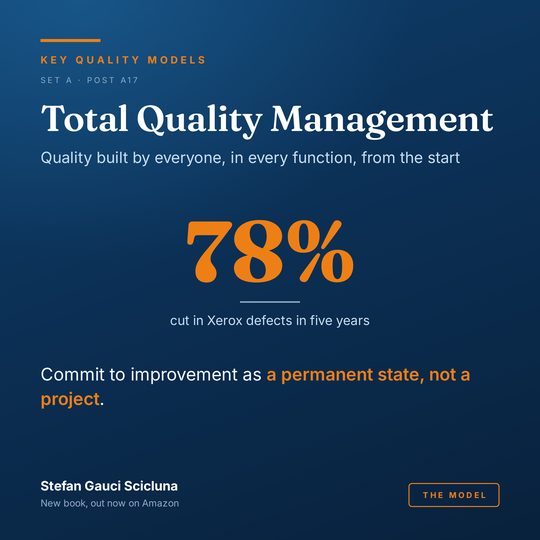
Put the customer at the centre and define quality by their needs. Involve everyone, because the person doing the work usually knows best how to improve it. Manage by fact, not opinion or rank. Treat the organisation as linked processes, not warring departments. Commit to improvement as a permanent state, not a project.

None of these on its own is TQM. The power is holding all of them at once, led visibly from the top, until they become the culture.

Under David Kearns, Xerox launched Leadership Through Quality. The scale of “total”: over 125 million dollars and four million hours in training. Three-quarters of a 50,000-strong workforce in over 7,000 improvement teams. Defects per hundred machines cut by 78% in five years.

Those teams generated 116 million dollars in savings in 1988 alone. Xerox reversed its slide.

That’s TQM as survival, not decoration.

The test of whether yours is real: if your most senior leader left tomorrow, would your quality culture survive them?

Sources: NIST: Xerox Baldrige Award profile, 1989 (PDF); Rochester Business Journal: David Kearns and quality at Xerox.

Longer read: Total Quality Management, and why it still matters

↑ All 20 models

Business Process Re-engineering: Do not automate the old process. Redesign the work. Illustrated card from Key Quality Models.

Key Quality Models · No. 18

Business Process Re-engineering

Do not automate the old process. Redesign the work

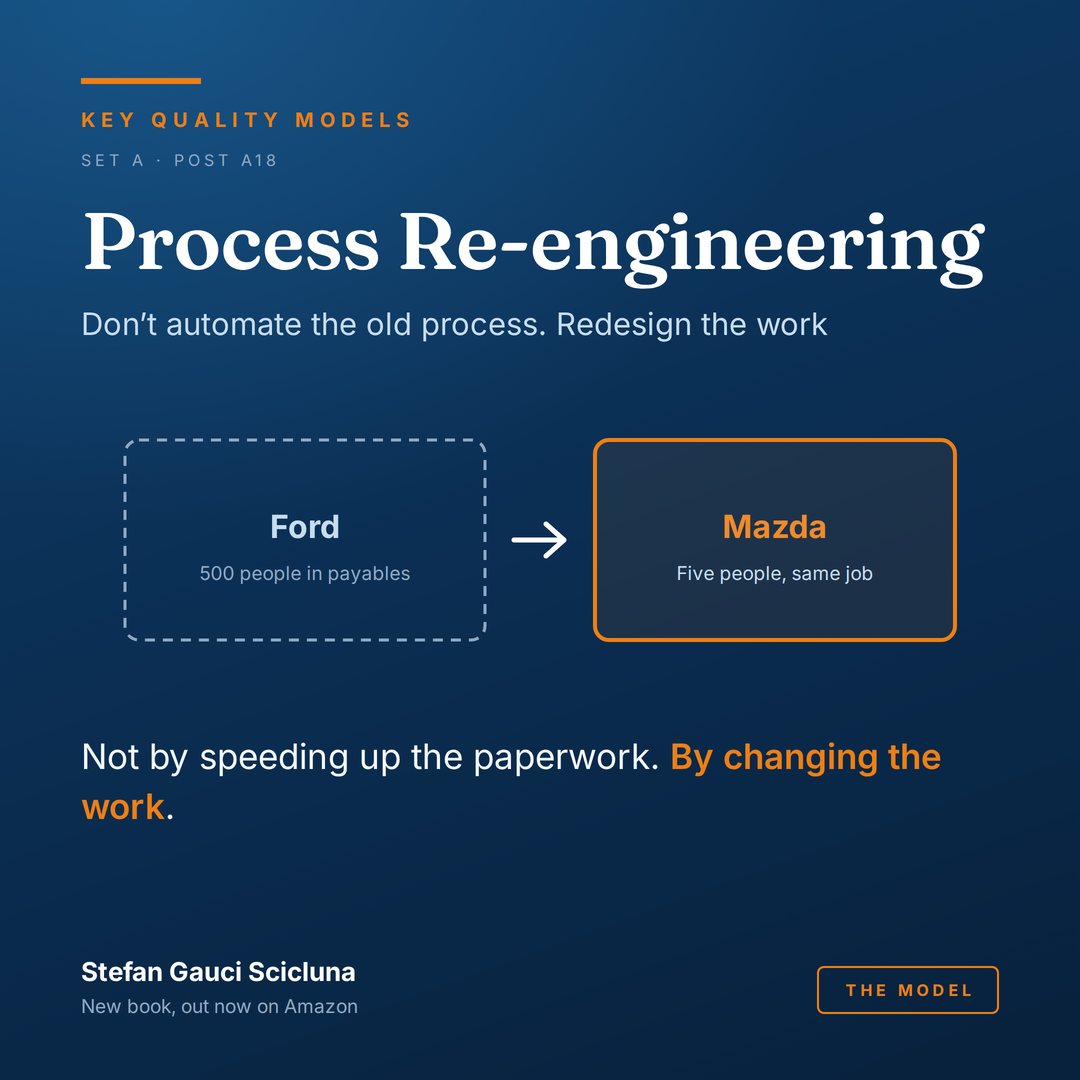
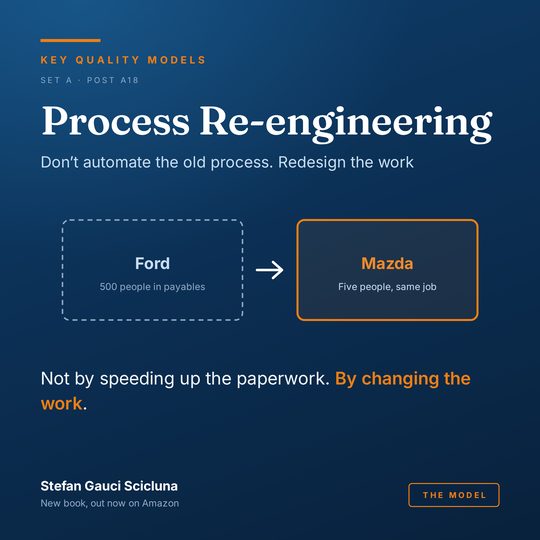
Ford ran its accounts payable with 500 people.

Mazda ran the same job with five.

That gap was too large to explain by scale. And it taught Michael Hammer the lesson behind Business Process Re-engineering.

By 1990, companies had spent years automating their existing processes and wondering why the gains were so small.

Hammer’s answer: they were paving cow paths. Computerising bad processes instead of rethinking them.

Don’t automate, he wrote. Obliterate.

BPR asks a heretical question: if you were starting this company today, with a blank sheet, would you design the work this way at all?

Usually the answer is no.

So Ford stopped automating its old three-way match of purchase order, receipt and invoice. It redesigned the process itself. Purchasing entered the order into a shared database. The loading dock confirmed the goods against it. Payment triggered automatically. The invoice was eliminated altogether.

The result: headcount cut by roughly 75%, from around 500 to about 125.

Not by speeding up the paperwork. By changing the work.

A warning, though. BPR became linked in the 1990s with heavy layoffs and top-down disruption. Used as a slogan for cost-cutting, it damages more than it fixes. Used narrowly, on a genuinely broken process, with care for the people, it’s powerful.

Which process in your organisation would you never design this way if you were starting today?

That’s your candidate.

Sources: Harvard Business Review: Hammer, Don't Automate, Obliterate, 1990; NTNU (hosted copy): full text of Hammer's 1990 HBR article (PDF).

↑ All 20 models

Six Sigma and DMAIC: Define, Measure, Analyse, Improve, Control. Illustrated card from Key Quality Models.

Key Quality Models · No. 19

Six Sigma and DMAIC

Define, Measure, Analyse, Improve, Control

An engineer at Motorola noticed something everyone else had missed.

The products that needed rework on the line were the same ones that failed early in the customer’s hands.

Faults didn’t hide. If you built it wrong and patched it, the customer paid for the patch later.

That single observation, that internal defects predict field failure, is the seed of Six Sigma.

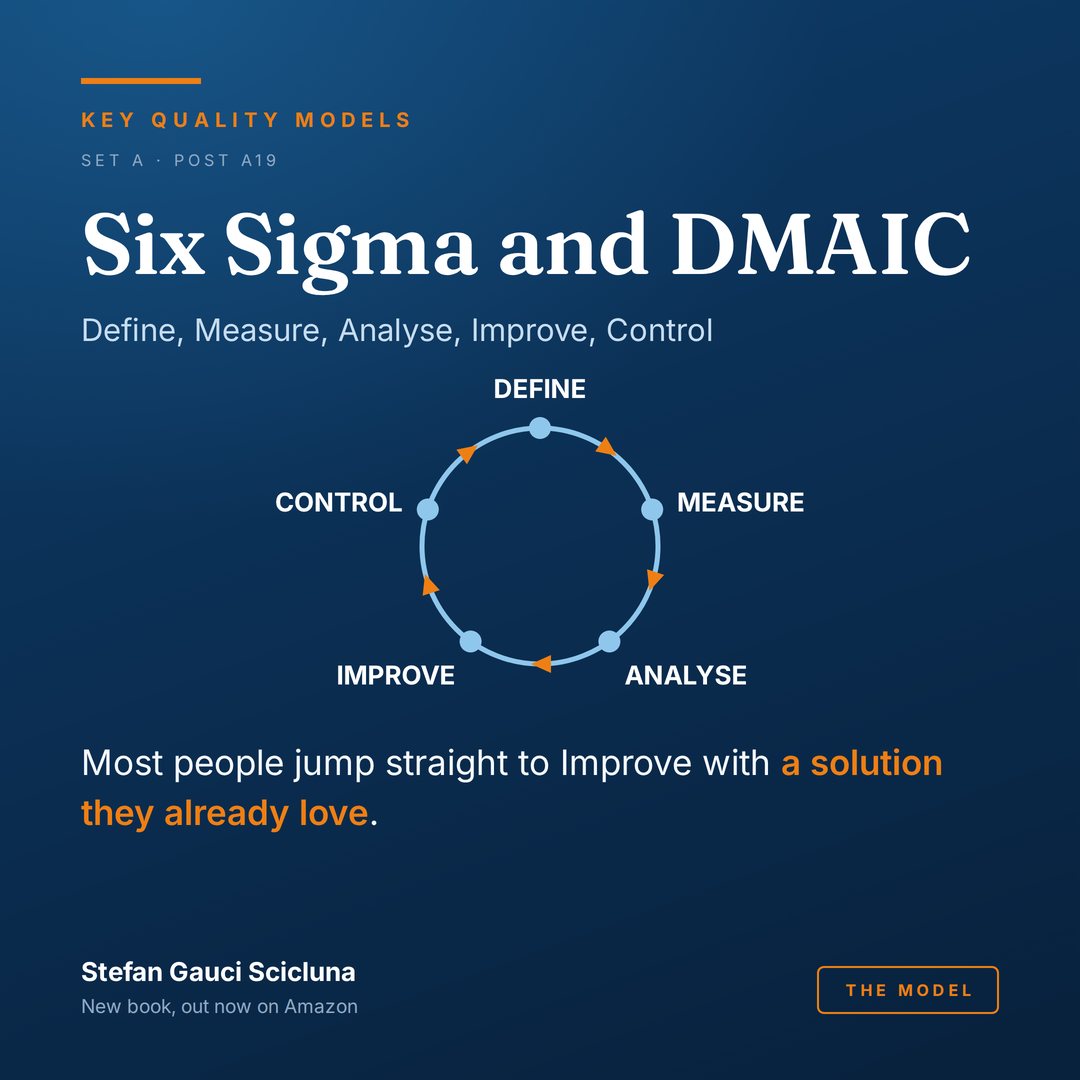
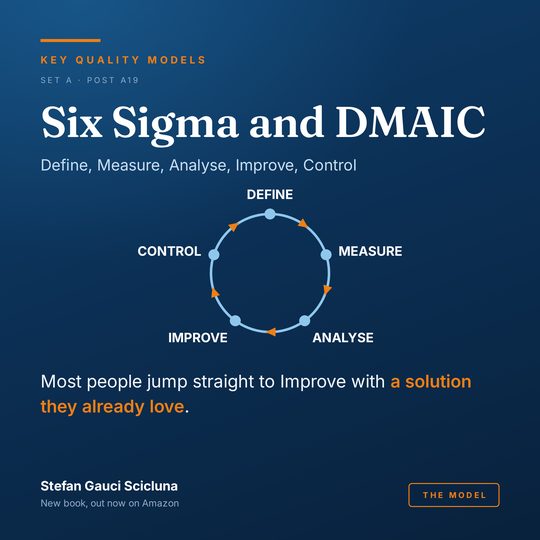
Six Sigma sets a hard, countable target: roughly 3.4 defects per million opportunities. Then it hands you a disciplined route to get there, called DMAIC:

Define the problem in the customer’s terms. Measure the current process before you touch it. Analyse the data to find the real drivers of variation. Improve by changing those drivers. Control, so the gain doesn’t quietly leak away.

The discipline is in the order. Most people jump straight to “Improve” with a solution they already love, before they’ve measured anything.

DMAIC forces you to measure the baseline first, and prove the cause with data rather than opinion.

Projects are chosen for money, not for tidiness. Practitioners carry belt grades, Green and Black, like a craft.

Reach for it when you have an existing process that underperforms, the cause is unclear, and you have enough data to be honest.

One question for your next improvement: have you measured the baseline, or are you about to fix a cause you’ve merely assumed?

Sources: NC State University: Bill Smith and Six Sigma's Motorola origins; ASQ: Six Sigma, DMAIC and 3.4 defects per million.

Longer read: Six Sigma without the belts and the mysticism

↑ All 20 models

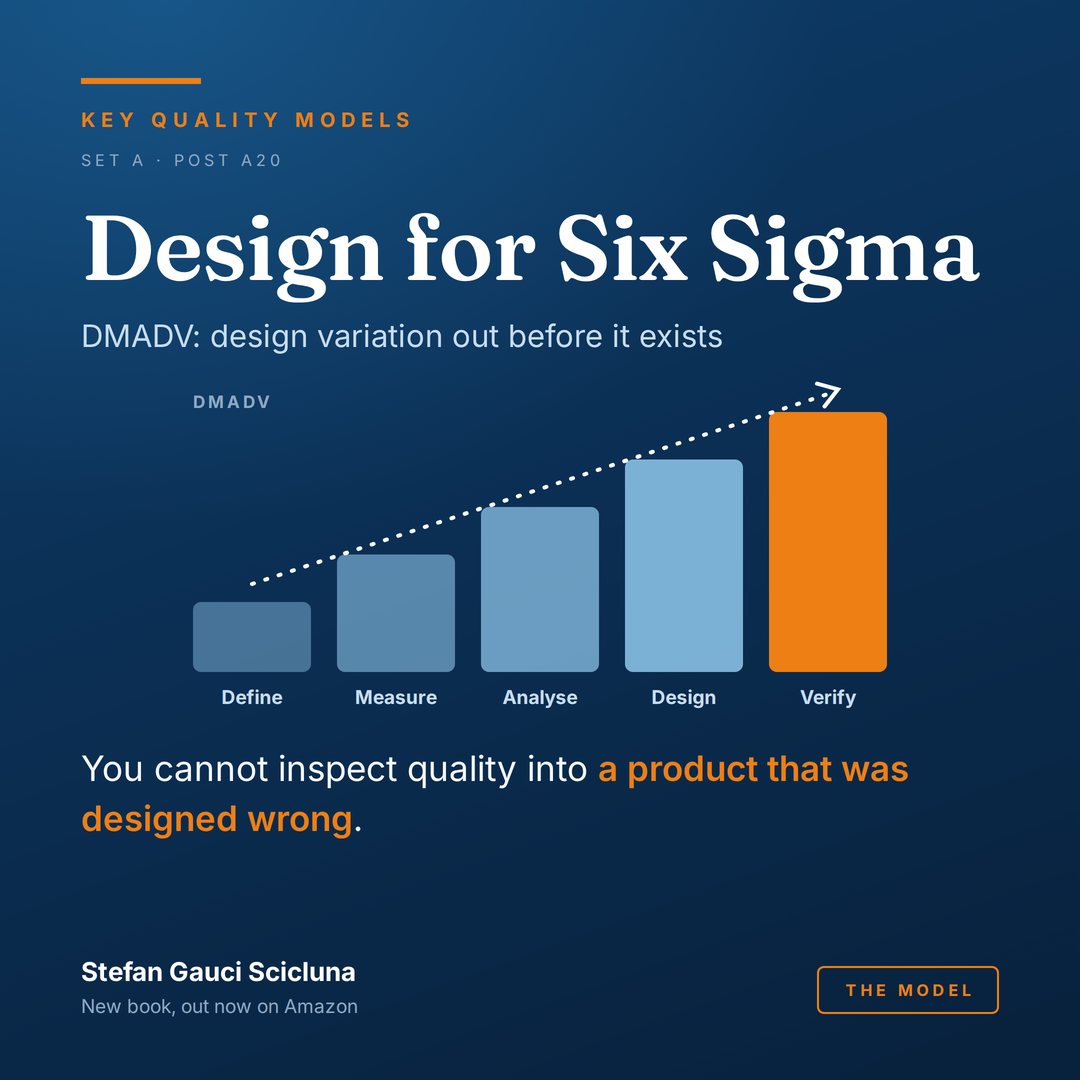
Design for Six Sigma (DMADV): DMADV: design variation out before it exists. Illustrated card from Key Quality Models.

Key Quality Models · No. 20

Design for Six Sigma (DMADV)

DMADV: design variation out before it exists

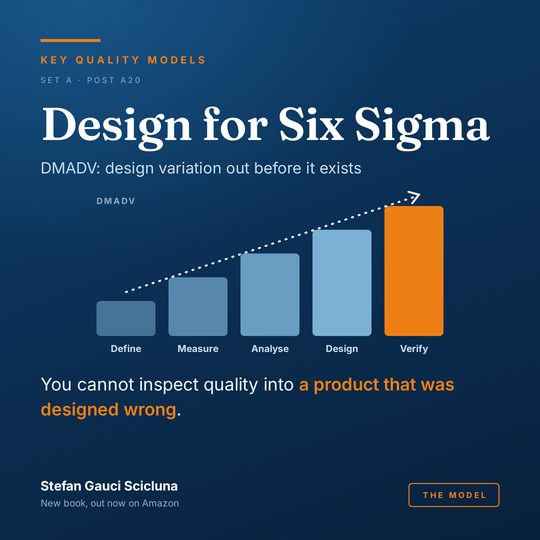
You cannot inspect quality into a product that was designed wrong.

By the time it reaches the line, the decisions that matter have already been made.

Standard Six Sigma improves a process that already exists. But most quality is decided far earlier, on the drawing board, before a single unit is built.

That’s what Design for Six Sigma is for. Its method is DMADV:

Define the goals in the customer’s terms. Measure what the customer actually values, precisely. Analyse the design options against those values. Design the product or process to meet them. Verify that it performs before you commit.

The difference from DMAIC is the whole point. You can’t measure a process you haven’t built yet.

So instead of fixing variation after the fact, you design it out before it exists.

This matters most when the cost of getting it wrong is high, and the fix later is nearly impossible. A new product. A new service line. A new process where retrofitting quality would cost more than building it right.

The instinct in most organisations is to rush the design and rely on inspection to catch the problems.

But the earlier a defect is designed in, the more expensive it is to remove.

Where in your business are you rushing a design, planning to inspect quality in afterwards?

That’s where DMADV earns its place.

Sources: ASQ: quality glossary definitions of DMADV and DFSS.

↑ All 20 models

From the book

All books →
Cover of Key Quality Models by Stefan Gauci Scicluna

Quality assurance

Key Quality Models

The book covers fifty quality models and standards. Every one comes with a real case and its sources. What you see on this page are short versions of the first twenty.

View on Amazon →

Related

If one of these models describes a problem you have, this is where to go next.

Service

Quality assurance

I build ISO 9001 quality systems, design courses and curricula, and get training providers ready for accreditation.

Insights

Business Insights

Both sets of posts start here. All forty models are listed on the one page.

Enquire

Start a conversation

Tell me who you are and what is pressing on you. I will reply on whether I can help and what it would involve.

Common questions

What is a quality model?

Think of it as an agreed way of doing one of three things: running the work, improving it, or judging how consistent it is. Some are methods for improving, like PDCA, Kaizen and Six Sigma. Some are standards you can be certified against, and ISO 9001 is the best known. Others, like EFQM and Baldrige, are award frameworks that you score yourself against.

Which quality model should a small business start with?

This is my opinion. Begin with PDCA and the process approach. Neither costs anything, and neither needs a quality department. ISO 9001 is worth the effort later. The usual trigger is a customer, a tender or a regulator asking to see a certificate. The other trigger is size. At some point the owner can no longer check everything in person.

Are the company cases real?

Yes. Each case names a real organisation. The figures were checked against published sources in October 2026. The links are under each post, so you can read the sources for yourself.

Is ISO 9001:2026 covered?

The ISO 9001 post explains what the standard asks of you, and that has not changed in substance. The new edition came out on 16 September 2026. If you already hold a certificate, the quality assurance page explains what the change means for you.

These posts are written by Stefan Gauci Scicluna and reflect his own analysis, with sources shown. They are general explanation and not advice on your situation. Company cases are described from published sources as they stood when checked in October 2026.

Make an enquiry