In November 2022 a man in British Columbia asked Air Canada’s website chatbot about bereavement fares. His grandmother had just died. The chatbot told him to buy a normal ticket and claim the discount back within 90 days. That was not the airline’s policy, and when he applied, Air Canada refused. In February 2024 the province’s Civil Resolution Tribunal ordered the airline to pay him CAD 650.88 plus interest and fees.1 What stuck with me was the defence. Air Canada argued that the chatbot was a separate legal entity responsible for its own actions. The tribunal member, Christopher Rivers, called that remarkable and threw it out.2
Six hundred and fifty dollars. Air Canada will have spent more than that on the lawyers. But read the file and you see what actually went wrong: nobody had sat down and asked what the bot might say to a grieving customer, so nobody caught it, and the airline ended up owning an answer it never meant to give. There was no villain. There was a tool somebody bought, switched on, and left to get on with it.
I keep coming back to that because the tools have moved on a long way since 2022. A chatbot answers questions. What is being sold now does things. One of them will write the follow-up to a prospect and send it without anyone reading it first. Another books the meeting straight into your diary. A third amends the CRM record, and the one I would watch most closely rings your overdue customers. The sellers call them digital workers, or AI agents. One of the better-known names in the UK is Implement AI, founded in London in 2023 by Piers Linney, who many people will remember from Dragons’ Den, and Dr Aalok Shukla. Its pitch is that you can start with a single digital worker and scale to fifty across sales, support and analysis, and its strapline is “grow your workforce, not your payroll”.3 I am not picking on them. If anything the opposite: a serious company with a BBC name on the door is a sign that this has stopped being a science project.
So the question for a managing director is no longer whether to try one. It is this: when the digital worker gets it wrong, who was supposed to stop it, and will you be able to prove that someone was?
What the law expects
Start with what the law expects, because it is less dramatic than the headlines and more demanding than most buyers assume.
In the EU, the AI Act’s heavy obligations for high-risk systems were due to bite on 2 August 2026. They did not. The Digital Omnibus, agreed in May and now published as Regulation (EU) 2026/1744, pushed the stand-alone high-risk list (recruitment, credit decisions, education and the like) back to 2 December 2027, and embedded systems such as medical devices to August 2028.4
I would not relax on that account. Picture a Maltese insurance broker whose new digital worker handles the first chat with every visitor to the website. Under Article 50, which was not delayed and has applied since 2 August 2026, that visitor is entitled to know they are chatting to software. Picture the same broker’s sales assistant, who now sends outreach the agent drafted. Article 4 has been on the books since February 2025, and the omnibus changed its verb from ensuring staff are AI-literate to supporting them in becoming so.5 Softer, yes. But if a regulator or a claimant asks what the broker did to help that assistant understand the tool, the honest answer cannot be nothing.
The UK has no AI Act. What it has is the existing law doing its job: UK GDPR and the Data (Use and Access) Act 2025 on automated decisions and personal data, the consumer protection rules on misleading actions, which since April 2025 sit in the Digital Markets, Competition and Consumers Act 2024, and the ordinary law of contract and negligence that caught Air Canada.6 The ICO has been clear for years that an organisation remains the controller for what its tools do with personal data.7 “The software did it” is not a defence in Manchester any more than it was in Vancouver.
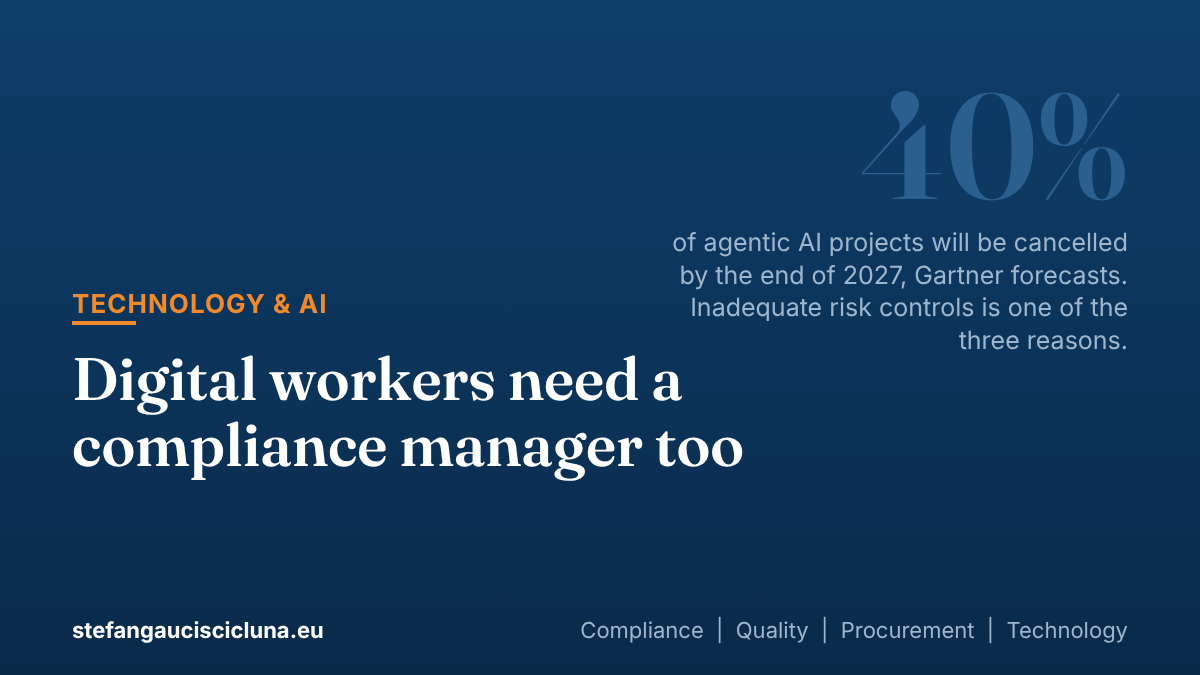
Then the number that should make a finance director sit up. Gartner’s forecast of June 2025 was that more than 40 per cent of agentic AI projects would be cancelled by the end of 2027. Anushree Verma, the analyst who wrote it, blamed rising costs, unclear business value and inadequate risk controls, in that order. The same note reckoned that of the thousands of vendors calling their products agentic, only about 130 were the real thing. Gartner called the rest “agent washing”.8 That is a market where the buyer needs a method, not a demo.
Treat it as a role, not an app
What I would actually do, if a client rang me on Monday and said the agent goes live on Friday, is not very different from what we do when they hire an account manager. ISO 37301, the standard we build compliance systems to, was written around roles and the obligations attached to them, and it has never asked who or what fills the role.9 So we would sit down with the same list we always use, and most of the hour would go on the second item.
The first item is obligations. For a sales agent sending outreach they are not hard to find: PECR for the marketing email, a lawful basis under GDPR for the list it is working from, consumer law for whatever it says about the product. Twenty minutes, written down, done.
The second is ownership, and this is where I have watched it fall apart more than once, in firms that were otherwise well run. The managing director signed the vendor contract and assumed IT had it. IT set up the integration and assumed sales had it. Sales was delighted with the meetings and had not read a single one of the emails that produced them. The compliance officer heard about the whole thing at the quarterly review, from a customer complaint. Nobody had been negligent, exactly. The job simply had no name against it.
Third, the controls, which I like short enough to fit on one page: the things the agent may never say, the most it may ever offer, and a rule that nothing goes to a customer with an open complaint without a person reading it first. Fourth, monitoring, which means a name, a day of the week and a number of conversations to sample. Fifth, records. When a customer disputes what was promised, and one will, we want the full exchange retained, and the approved version of the script the agent worked from, dated and signed off by whoever approved it. That is the file the Air Canada tribunal would have asked for.
I should say something for the other side, because there is one and vendors are entitled to make it. A properly set-up digital worker logs everything, which a human adviser does not. It gives the same answer at five to six on a Friday as at nine on a Monday. Implement AI, to take the firm I mentioned, sells on precisely these points: approval steps with a person in them, audit trails, integrations that keep the record in your own CRM rather than theirs.3 I have no quarrel with any of that. The platform can supply the switch. It cannot supply the person whose job it is to throw it.
The tool
Five questions before any digital worker goes live
The same five we ask of any new role under ISO 37301. If you cannot answer one in writing, that is the gap to close before launch, not after the first complaint.
- Obligations. Which laws and contracts does this job touch? For a sales agent: PECR, GDPR lawful basis, consumer law on claims, your own terms of business.
- Ownership. Which named person is accountable for what it does, reads its output, and can switch it off without asking?
- Controls. One page: what it may never say, the most it may offer, and when a person must read before anything is sent.
- Monitoring. Who samples its work, on which day, and how many conversations? Written down, with the results kept.
- Records. Can you produce the full exchange with a customer, and the approved, dated version of the instructions it was working from?
Red line: if a wrong answer could cost a customer money, breach a regulation or create a legal commitment, the agent drafts and a person sends. No exceptions in the first ninety days.
What to do on Monday
So what do you do on Monday if a digital worker is already in the building, or a vendor is coming in on Thursday?
Write the job description first, before the demo. One page. What the agent may do on its own, what it may only draft for a person to send, and what it must never touch. If you cannot fill that page, you are not ready to buy, whatever the salesperson says about ninety-day returns. The page then goes to whoever owns compliance, who adds the obligations that apply and signs it. That signature is the first record in the file.
Then give the thing a line manager. A named person, not a department, who reads a sample of what it did every week and can switch it off without asking anyone. In a firm of thirty people that is probably the operations lead. In a firm of three hundred it might be a product owner with the compliance officer looking over the shoulder once a month. Either way, the name goes in the register next to the agent’s name.
Put the transparency notice in before launch, not after the first complaint. In the EU that is now the law under Article 50. In the UK it is simply good sense, and the ICO will expect it wherever personal data is involved. “You are talking to an automated assistant” costs nothing and removes the Air Canada argument before it starts.
Then go back to the vendor and ask the questions that matter more than the price. Where does the conversation log live, and can we export it tomorrow if we leave? Who can change the agent’s instructions, and is every change dated and attributed? What happens when the agent is not sure: does it guess, or does it stop and hand over? Can we set a hard ceiling on what it may offer a customer? And which of our obligations does your platform help us evidence, as opposed to merely promising to? A good vendor answers these in detail. Implement AI, to be fair, makes several of them part of its pitch. A vendor who changes the subject to the demo has told you what you need to know.
Last, run it for a month as a draft-only worker. Let it write, let a person send. Compare what it produced with what a person would have produced, count the corrections, and only then take the hand off the switch.
Five questions for the vendor, before the price
- Where does the conversation log live, and can we export all of it the day we leave?
- Who can change the agent’s instructions, and is every change dated and attributed to a person?
- When the agent is unsure, does it guess or does it stop and hand over to a human?
- Can we set a hard ceiling on what it may offer or promise a customer?
- Which of our legal obligations does your platform help us evidence, not just meet?
Where I come out
I am not against any of this. My own doctoral research is on what AI does to how managers run operations, quality and compliance, and I expect most of the firms we work with to have at least one digital worker on the books within two years. The ones that get value from it will be the ones that treated it as a hire, with a job description, a line manager and a file, rather than as an app. (For where AI does earn its place in day-to-day operations, see AI in operations.)
Air Canada’s bill was six hundred dollars. The real cost was explaining to a tribunal why nobody had read what the bot was saying. Linney’s line is “grow your workforce, not your payroll”, and it is a fair one. Just remember that a workforce, however it is paid, needs a compliance manager. That part does not come in the box.
Notes and sources
- Moffatt v. Air Canada, 2024 BCCRT 149, Civil Resolution Tribunal of British Columbia, decided 14 February 2024: chatbot advice on bereavement fares in November 2022; damages of CAD 650.88 plus interest and tribunal fees. Summarised by Manatt, “AI gone wild: airline has to honor a refund policy its chatbot fabricated”, 28 February 2024. Link. ↩
- Law360 Canada, “Court rejects Air Canada’s ‘remarkable’ denial of liability regarding misinformation by its chatbot”, February 2024, on the separate-legal-entity argument and tribunal member Christopher Rivers’s rejection of it. Link. ↩
- Implement AI: founded 2023 in London by Piers Linney and Aalok Y. Shukla; AI Operating System (AIOS); £1.3 million seed round September 2025; UK Startup Awards AI Start-Up of the Year (London) 2025. Wikipedia, “Implement AI” and “Piers Linney”. The “single digital worker… scale to 50 or more” claim, the “grow your workforce, not your payroll” strapline, 600+ integrations and human-in-the-loop workflows are from the company’s own podcast descriptions. Wikipedia; Implement AI Podcast, Apple Podcasts; episode 71. ↩
- Orrick, “EU AI Act update: Digital Omnibus finalizes 8 compliance changes”, 29 July 2026: Regulation (EU) 2026/1744 published in the Official Journal; Annex III high-risk obligations from 2 December 2027, Annex I from 2 August 2028, public authorities 2 August 2030. Link. ↩
- Gibson Dunn, “EU AI Act Omnibus agreement: postponed high-risk deadlines and other key changes”, May 2026: political agreement 6 May 2026, confirmed by the Council 13 May; Article 50 transparency obligations unaffected from 2 August 2026 (grace period to 2 December 2026 for Article 50(2) on systems already on the market); Article 4 AI literacy in force since 2 February 2025 and reworded to “support the development of AI literacy”. Link. ↩
- Data (Use and Access) Act 2025, c. 18, and Digital Markets, Competition and Consumers Act 2024, c. 13 (consumer protection provisions in force from 6 April 2025), legislation.gov.uk. DUAA 2025; DMCC Act 2024. ↩
- Information Commissioner’s Office, Guidance on AI and data protection (controller and processor responsibilities, accountability and governance). Link. ↩
- Gartner, “Gartner predicts over 40% of agentic AI projects will be canceled by end of 2027”, press release, 25 June 2025 (Anushree Verma): rising costs, unclear business value, inadequate risk controls; about 130 genuine agentic AI vendors among thousands; “agent washing”. Gartner; also reported by New Electronics. ↩
- ISO 37301:2021, Compliance management systems: requirements with guidance for use, International Organization for Standardization. Link. ↩